 AnswerLion
branded SEO reporting
Branded SEO Reporting: Measuring AI Visibility and Impact
Build branded SEO reporting that proves AI assistant visibility and business impact to stakeholders, with the metrics, attribution checks and report layout.
Published · Updated · By AnswerLion
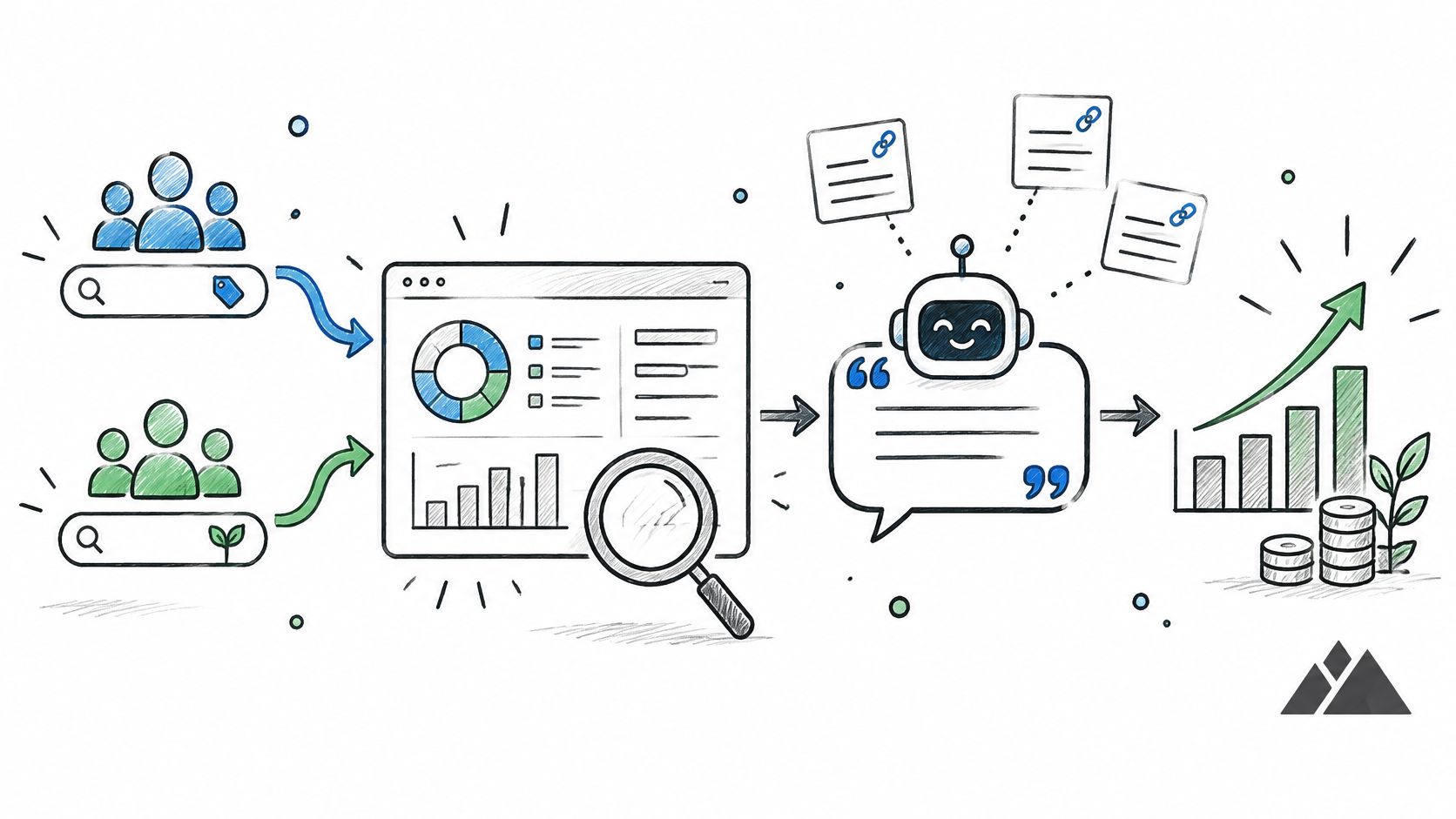
Branded queries represented 45.7% of total search volume in a 2025 Ahrefs analysis of approximately 150 million U.S. Google keywords. That makes branded search too important to bury inside an organic-traffic total, and too easy to misinterpret as evidence that SEO created new demand.
For a CMO, the useful distinction is between creating recognition, capturing existing demand, and converting that demand into revenue. Branded SEO reporting should measure those activities separately, with AI assistant visibility alongside them rather than folded into the same performance claim.
Table of Contents
- Why Branded Search Needs Its Own Report
- The Core Metrics Every Branded Report Needs
- How to Separate Branded and Non-Branded Demand
- Tracking AI Assistant Visibility Next to Search
- Attributing Revenue and Diagnosing Branded Trends
- Build Your First Branded Report This Month
Why Branded Search Needs Its Own Report
Branded searches come from people looking for a company, its products, or its services by a recognizable name. Non-branded searches describe a problem, category, or requirement without naming that business. Combining them hides a fundamental difference in customer intent.
The Ahrefs analysis found that branded terms accounted for a smaller share of distinct queries than of search volume. In plain terms, branded searches involved fewer unique keywords but attracted more searches per keyword. An aggregate traffic chart therefore conceals how much activity comes from existing recognition rather than broader discovery.
Branded SEO reporting is a monthly view that separates demand for the business from demand for topics, measures each segment independently, and connects both to commercial outcomes. It gives stakeholders a clearer basis for deciding whether to invest in awareness, search-result presentation, acquisition content, or conversion improvements.
Separate recognition from discovery
Think of a shop till. Total takings tell the owner how much money came in, but not whether customers discovered the shop that morning or had visited for years. Organic traffic needs the same distinction.
A useful executive report answers these questions:
- Is the brand being found? Track searches that identify the company or its distinctive offerings.
- Is discovery expanding? Examine visibility for relevant queries that don’t name the business.
- What did that attention produce? Connect visits to qualified leads, purchases, and attributed revenue.
A public-relations campaign, customer referral, or repeat purchase can produce a branded search. SEO may capture that demand effectively without having created the initial awareness. Recognizing that contribution accurately makes the report more useful, not less positive.
The reporting view should make those different sources of demand visible.
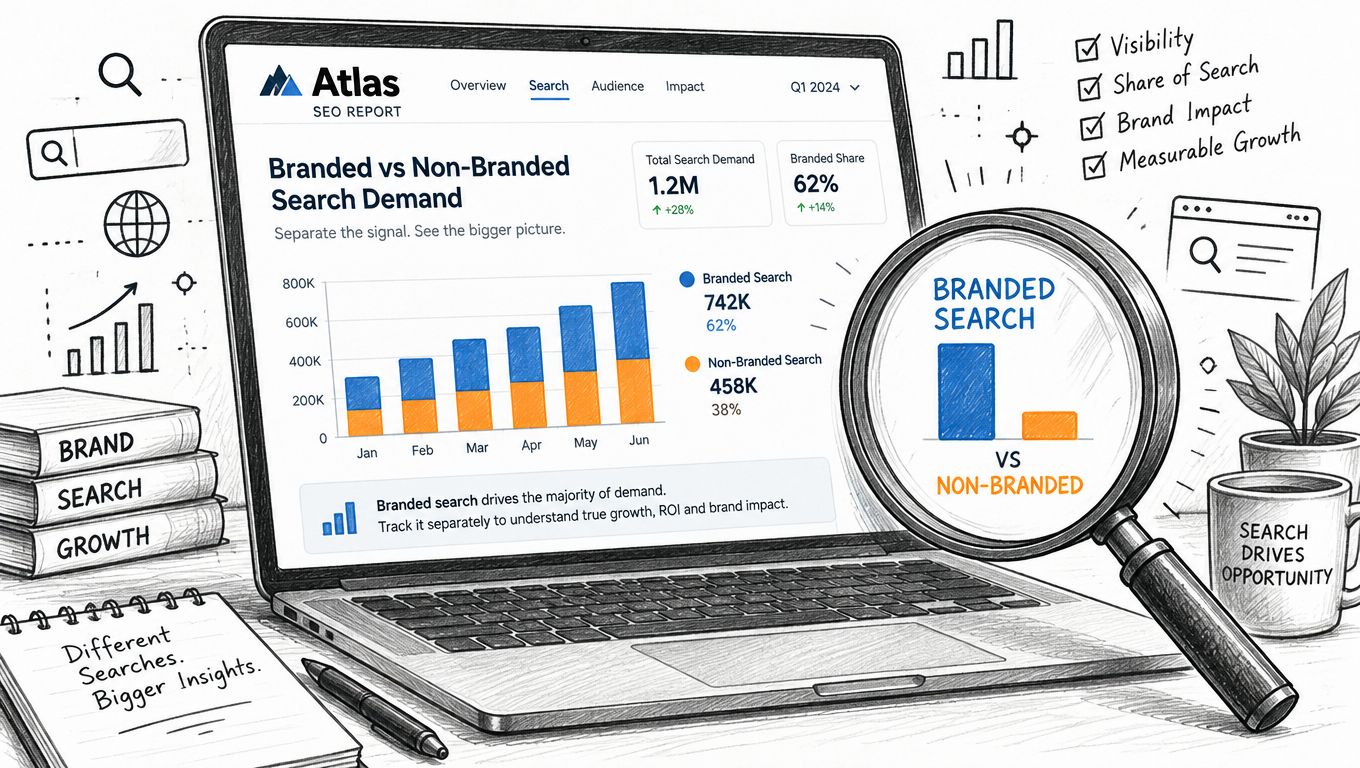
Reporting principle: Give SEO credit for the demand it captures and the discovery it earns. Assign demand creation only where the evidence supports it.
The Core Metrics Every Branded Report Needs
Core metrics for a branded SEO report
| Metric | Question it answers | Segment | Source |
|---|---|---|---|
| Branded impressions | How often people saw the brand in results | Branded query filter | Search Console Performance report |
| Branded clicks | How many people chose the brand’s listing | Branded query filter | Search Console Performance report |
| Branded CTR | Whether the listing earns the click when shown | Branded query filter | Clicks divided by impressions |
| Average position | Topmost position averaged across impressions | Branded and non-branded | Search Console Performance report |
| Non-branded impressions and clicks | Whether SEO reaches people who do not know the brand | Non-branded queries | Search Console Performance report |
| Conversions by landing page | Which brand pages produce outcomes | Branded landing pages | Google Analytics |
| Revenue or qualified leads | What branded organic visits were worth under the stated model | Branded organic | Google Analytics with named attribution model |
| Country and device split | Where branded demand is growing | Country and device | Search Console API |
Google Search Console’s performance documentation defines impressions as appearances of a site link in Google Search, clicks as clicks from those results, and average position as the site’s topmost position averaged across impressions. These measures describe visibility, engagement, and prominence, respectively.
An impression doesn’t establish that someone recognized or considered the brand. A click establishes that someone selected a result, not that the visit was qualified. Average position isn’t a fixed ranking for every keyword or page, so always present it alongside impressions and clicks.
Connect search activity to outcomes
Branded CTR, calculated as clicks divided by impressions, measures how often a displayed result earns a click. Read it within a consistent query segment: changing the mix of navigational, product, and support searches can change aggregate CTR without any listing improvement.
Keep the non-branded comparison equally specific. Non-branded visibility indicates reach beyond explicitly brand-named searches, but it doesn’t identify every searcher as a new customer. Existing customers can use category terms too.
For outcomes, use Google Analytics to show conversions by landing page and revenue or qualified leads under a named attribution model. A branded landing page isn’t proof of a branded query: a homepage or product page can receive both branded and non-branded visitors. Label page-level outcomes as a supporting view rather than an exact query-to-revenue match.
Maintain a separate measurement dictionary for AI brand mentions. An assistant mentioning a business isn’t equivalent to a search impression, and neither establishes a site visit.
For reproducible extraction, Google’s branded-query guidance describes segmentation and API reporting across dimensions such as query, page, country, and device. Choose metrics the team can refresh reliably, store the exports in a shared sheet or reporting pipeline, and preserve definitions between reporting periods.
How to Separate Branded and Non-Branded Demand
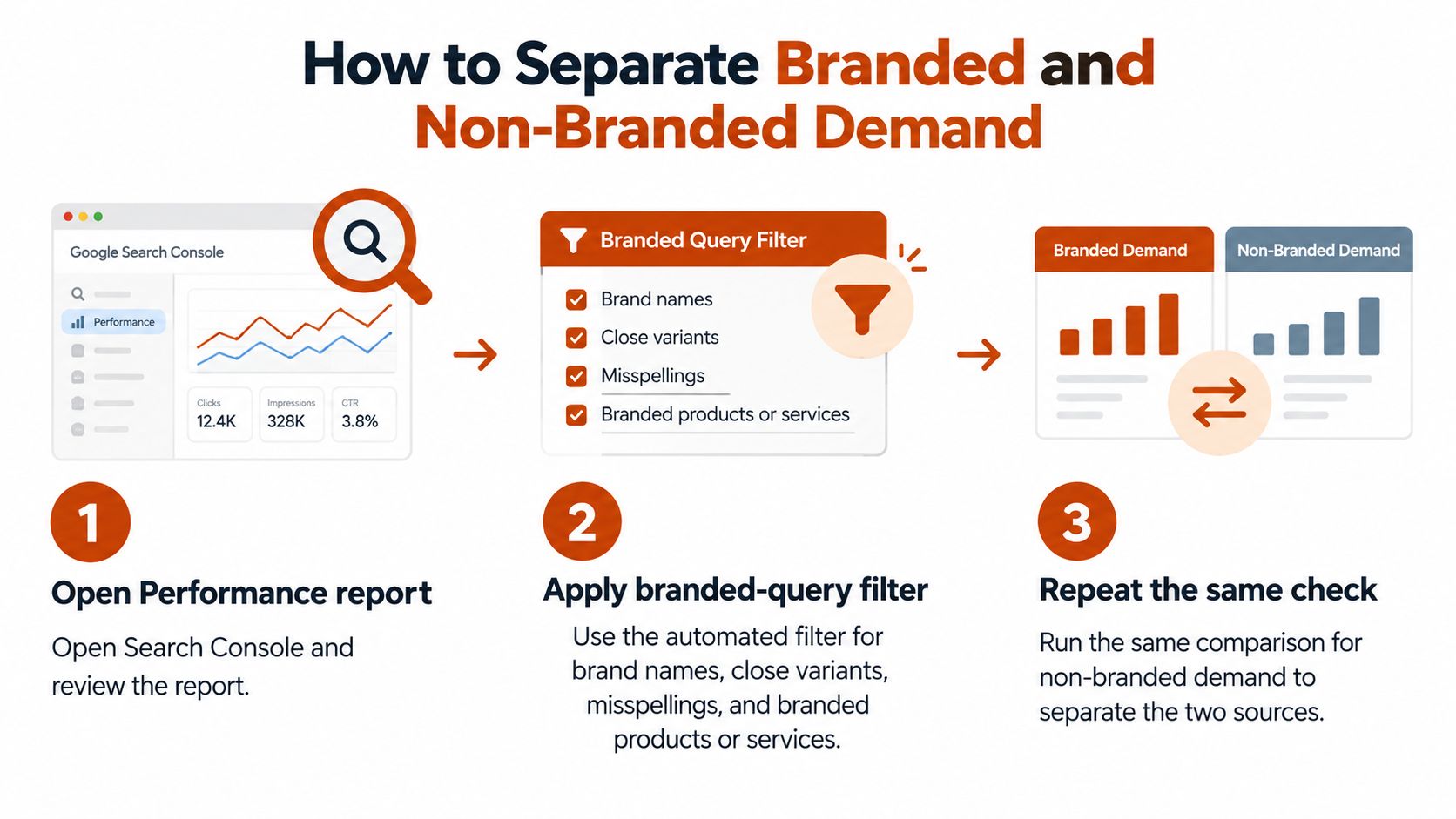
Start with a documented classification policy, not just a keyword include list. Google’s branded-query filter guidance describes an AI-assisted system covering brand names, variants, misspellings, multiple languages, and distinctive products or services, while noting classification errors and availability limits.
The workflow separates the search segments before commercial interpretation begins.
-
Open the Performance report and apply the branded-query filter. Review representative queries to confirm that company names, close variants, misspellings, and branded products or services match the intended reporting scope.
-
Repeat the export for non-branded demand using identical dates. Keep search type and property scope consistent so differences reflect the segments rather than incompatible settings.
-
Publish the classification policy. List included brand terms, regional names, product names, and misspellings, then state exclusions so another analyst can reproduce the logic.
-
Maintain an exception log. Record ambiguous category terms, disputed product references, and anonymized-query exclusions because query-filtered totals don’t represent every search in the unfiltered report.
-
Confirm property eligibility. The automated filter isn’t available for low-impression sites, sub-properties, and some smaller datasets, so label any manual classification as a separate method.
-
Segment both views by country, device, and landing page. This identifies whether an apparent business-wide change is concentrated in a market, device group, or destination.
-
Annotate classification changes. If Google’s categorization changes, restate the prior period where reproducible data permits; otherwise, mark a break in comparability rather than presenting a continuous growth claim.
Resolve ambiguity before calculating growth
Say a software company’s name also describes a common business task. Treating every query containing that phrase as branded would inflate recognized demand. The policy should distinguish explicit company intent from generic task intent and preserve uncertain cases for review.
Separate company-name demand, product-led demand, and navigational demand where those distinctions affect decisions. A surge in login searches calls for a different response from growth in product-comparison queries. For multinational businesses, maintain market-specific definitions instead of assuming a single regular expression captures every language and regional name.
Record the gap between filtered and unfiltered totals, but don’t call it an exact anonymized-query share unless the reporting output supports that calculation. The sound test is reproducibility: another analyst should obtain the same segmentation from the same settings.
Use this walkthrough alongside the written classification policy.
Tracking AI Assistant Visibility Next to Search
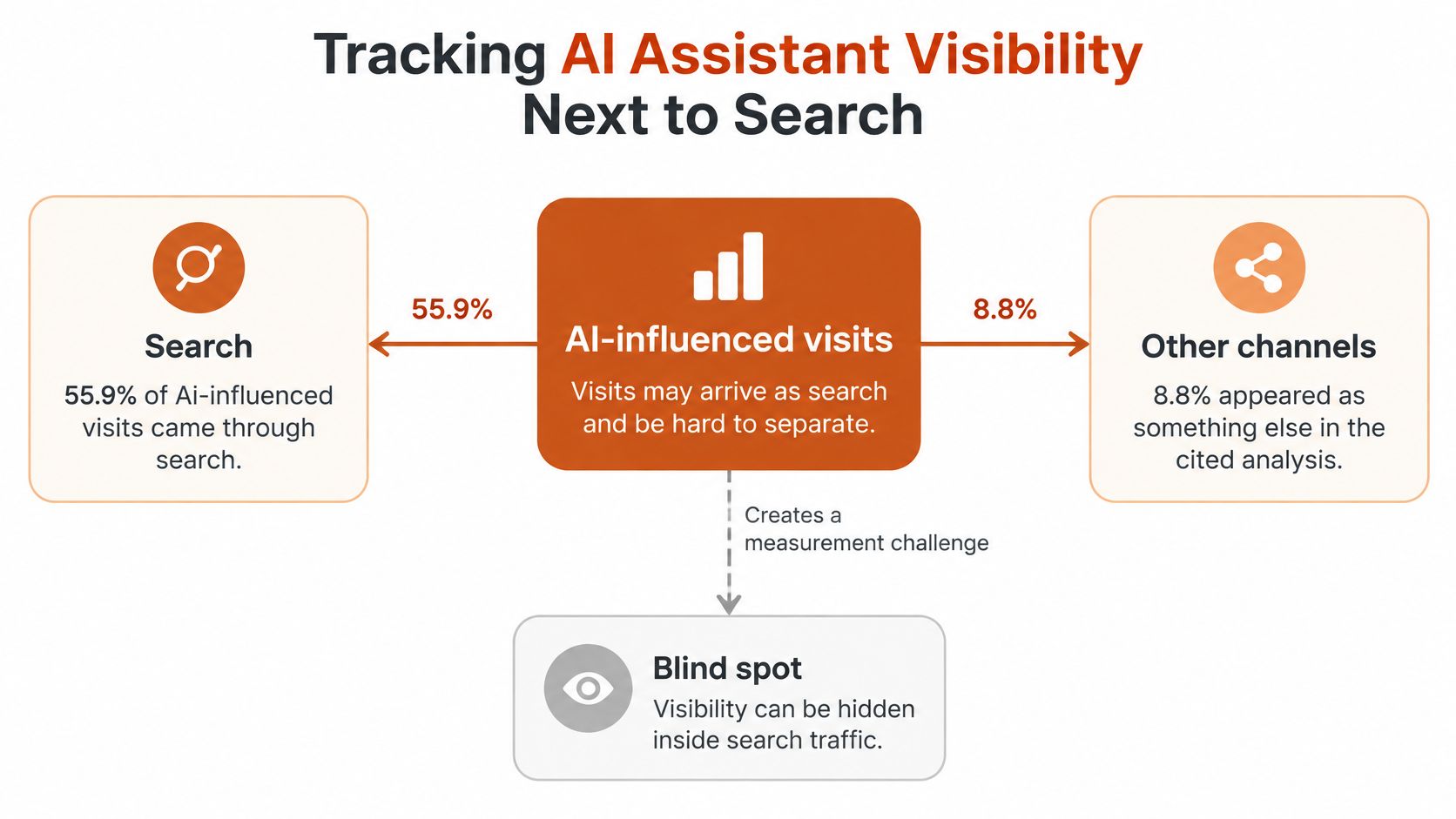
AI referral traffic alone misses part of AI-assisted discovery. PPC Land’s reporting on Similarweb analysis states that 55.9% of AI-influenced visits arrived through search, while 8.8% appeared as direct referrals from AI platforms.
The same reporting describes Seer Interactive’s analysis of 25.1 million organic impressions, which found a 61% CTR decline on queries showing an AI Overview between June 2024 and September 2025. That finding concerns the analyzed queries, not a universal forecast for branded search.
A buyer can ask an assistant for recommendations, search a recommended company in Google, and arrive through branded organic. The analytics channel records the route to the website, not necessarily the place where the buyer first encountered the brand.
The distinction is easiest to see as separate discovery and arrival events.
Keep an auditable assistant record
Run a fixed set of priority customer questions across ChatGPT, Perplexity, Claude, and Google AI Overviews. Store the prompt, engine, date, available location settings, answer, cited sources, and interpretation.
Place these measures beside search performance:
- Brand mentions and recommendations: Distinguish a passing reference from an explicit recommendation.
- Description accuracy: Record incorrect services, locations, positioning, or product details.
- Citation sources: Identify which pages and external references support the answer.
- Competitor inclusion: Track who appears when the business doesn’t.
- Branded prompts and product references: Keep questions naming the business separate from unprompted discovery.
A practical LLM visibility tracking record preserves the answer itself, not just a score. That lets stakeholders inspect why a result was classified as an improvement.
In our measurement process, results usually develop through accurate descriptions, then mentions for targeted questions, then visibility across related questions as authority builds. Track those stages independently so correcting a description doesn’t get reported as a new recommendation.
Interpret search movement alongside answer changes
A falling CTR deserves a results-page review before a copy rewrite. Likewise, rising branded clicks after assistant recommendations support an AI-influence hypothesis, not a proven user-level connection. Strengthen the diagnosis with conversion paths and a self-reported discovery question on lead forms.
Our monitoring re-runs priority questions on a regular schedule and reports where the business appears, what changed, and what to do next. Keep the established question set stable; add exploratory questions separately so changing coverage doesn’t masquerade as improved visibility.
Attributing Revenue and Diagnosing Branded Trends
Attribution assigns credit across touchpoints. It doesn’t prove that organic brand exposure caused a sale. That distinction lets a CMO recognize demand capture without overstating the channel’s role in creating demand.
Google Analytics’ attribution documentation describes data-driven attribution, paid and organic last click, and Google paid channels last click. Data-driven attribution calculates contributions using the property’s observed conversion data; the last-click models assign credit according to their eligible-channel rules.
Select the model that matches the reporting question and retain it across the comparison period. Put its name beside the outcome metrics, rather than leaving stakeholders to infer how revenue was assigned.
Read visibility and revenue as separate layers
The upper layer should show branded impressions, clicks, CTR, and average position. The outcome layer should show qualified leads, purchases, or revenue under the selected model. A favorable visibility movement becomes a commercial improvement only when the outcome evidence supports that conclusion.
Direct traffic needs particular care. Google Analytics excludes direct visits from attribution credit unless the entire conversion path consists of direct visits. A person who searches the brand and later returns directly therefore won’t necessarily appear as a simple final-visit branded-organic conversion.
A stronger branded-search result is a visibility finding. Incremental revenue is a different claim and requires different evidence.
Before explaining a movement, check the classification settings, then the attribution model, then campaign and journey evidence. This order prevents a reporting change from being presented as a customer-behavior change.
Branded trend symptoms, likely causes and checks
| Symptom | Likely cause | Check before presenting |
|---|---|---|
| Branded impressions rise, clicks flat | Weaker listing or tougher results-page competition | Review titles, descriptions and top results for those queries |
| Branded clicks rise, conversions flat | PR, offline activity or referrals driving brand demand | Compare with campaign dates and referral sources |
| Non-branded impressions rise | SEO reaching people who do not know the brand yet | Check whether the pages gaining impressions also convert |
| Direct traffic spikes with no campaign | Return visits from earlier search or AI exposure | Review assisted conversion paths |
| Branded AI-assistant mentions rise, branded clicks follow | AI recommendation credited to branded organic | Compare prompt-level citation logs with branded trend dates |
| Branded share shifts after a Google update | Change in Google’s classification, not performance | Annotate the chart and restate the prior period |
Treat the likely-cause column as a diagnostic starting point, not a verdict. A classification explanation requires evidence of changed categorization; an AI-assistance explanation requires relevant answer logs and supporting timing. When the evidence doesn’t distinguish between causes, name the competing explanations and assign the next check.
Turn symptoms into decisions
Say branded clicks increase after a public-relations announcement while qualified leads remain flat. If campaign timing and referral evidence align, report increased awareness captured through organic search. Then inspect query intent and landing-page behavior before recommending more acquisition spending.
The appropriate action could be clearer product information, better routing for investor or recruitment interest, or stronger qualification on enquiry forms. Calling every additional branded visit an SEO acquisition win would send budget toward the wrong problem.
For rising impressions with flat clicks, inspect the actual results for the affected queries. A new competing result, an answer displayed directly on the page, or a change in query mix calls for a different response from an unclear title. Segment the change before rewriting every brand-page description.
For expanding non-branded reach, evaluate the relevance of the pages and queries gaining visibility. Growth concentrated in informational content should be reported differently from growth on service or purchase-oriented pages. Both can be valuable, but they support different commercial expectations.
Verify access before prescribing content changes
An AI search visibility audit should distinguish a content problem from an accessibility problem. For Google specifically, its AI features guidance states that supporting pages must be indexed and eligible for a search snippet, and that no special schema markup or separate AI text file is required.
Check indexing, snippet eligibility, and controls such as noindex or nosnippet before treating an omission as evidence of weak authority. That produces a specific technical action rather than a vague instruction to publish more.
End every diagnosis with the observed change, the supported explanation, the business implication, and the next action. Where causation remains unresolved, make resolving it an assigned task. Precision gives executives a sounder basis for allocating budget than a dashboard that assigns every favorable movement to SEO.
Build Your First Branded Report This Month
Build a report stakeholders can read quickly and use to approve action. At the top, state whether any site changes occurred during the reporting period and identify the affected pages. Our policy is to show clients the report before making changes to their site.
Use this order for the monthly review:
- Executive summary. State what changed in branded demand, the best-supported cause, the commercial implication, and the recommended response.
- Search performance. Present branded and non-branded results with consistent dates, definitions, and market coverage.
- Attribution and outcomes. Name the model and show the trend in qualified leads, purchases, or revenue.
- AI assistant visibility. Identify the priority questions that named the business, those that cited competitors instead, and the material answer changes.
- Assigned actions. Give each approved task an owner, a due date, and an observable completion condition.
Establish the baseline before implementation
For the initial report, select customer questions that reflect actual buying decisions: service suitability, product comparisons, geographic availability, and requirements. Run them across the major AI engines, retain the answers, and record every missing or inaccurate business detail.
Keep observations separate from recommendations. An incorrect service description is an observation; rewriting the service page and correcting inconsistent external profiles are proposed fixes. That distinction gives stakeholders a clear approval decision and preserves an auditable record of what changed.
Decision standard: Every action should resolve a documented problem or test a named explanation.
Our reporting is designed to be readable in five minutes: what AI engines say now, what changed since last time, and what is being done next. Keep supporting exports and answer captures available beneath that summary rather than crowding the executive view.
This month, agree the metric definitions with SEO, analytics, and revenue owners. Run the baseline before implementation, document the classification policy, and book the first monthly stakeholder review. The immediate benefit is a shared account of what the team knows, what it needs to test, and where to act.
AnswerLion offers a standalone AEO audit that tests priority customer questions across every major AI engine, identifies who gets cited instead of your business and why, and delivers a prioritized fix list. Visit AnswerLion to establish an AI visibility baseline that sits alongside your branded SEO report and turns measurement into specific next actions.