 AnswerLion
ai answer engine
AI Answer Engine: What It Means for Brands
Learn what an AI answer engine is, the four types, how answers are built, and how brands earn a place in the response.
Published · Updated · By AnswerLion
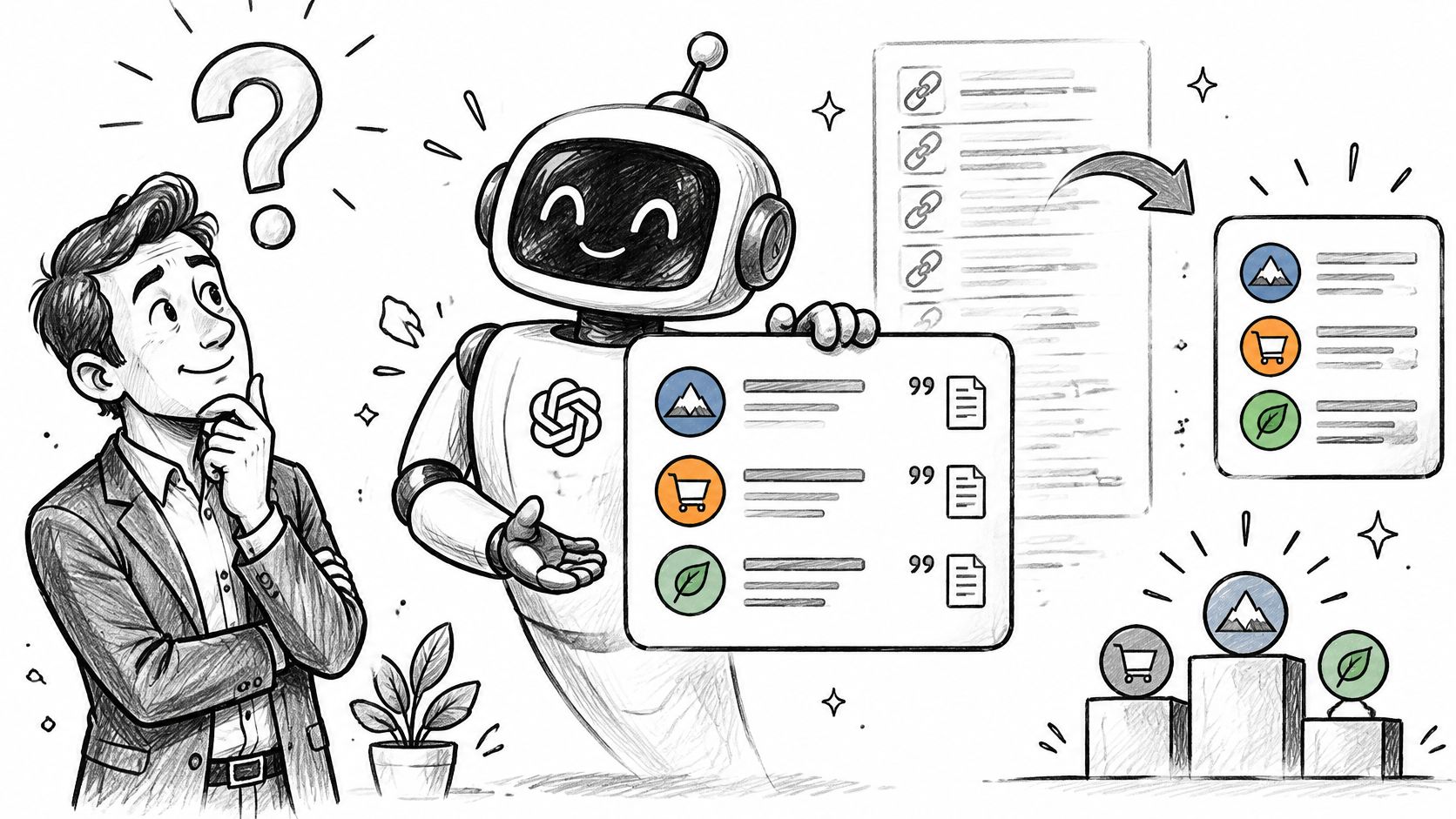
78% of organizations said they used AI in 2024, up from 55% in 2023, according to the Stanford University 2025 AI Index. For marketing leaders, that makes an AI answer engine more than another publishing channel. It’s a place where prospective customers can form a shortlist before they visit a company’s website.
The commercial opportunity is to be named for the right reason, with evidence that supports the recommendation. That requires separating retrieval, citation, and claim accuracy, because a mention without a supported claim is an incomplete win.
Table of Contents
- What an AI Answer Engine Is
- The Four Kinds of AI Answer Engines
- Diagnosing Retrieval, Citation, and Claim Accuracy
- Where Buyers Already Use Answer Engines
- What Publishers Can Change This Month
- Confirm Your Baseline Before You Invest
What an AI Answer Engine Is
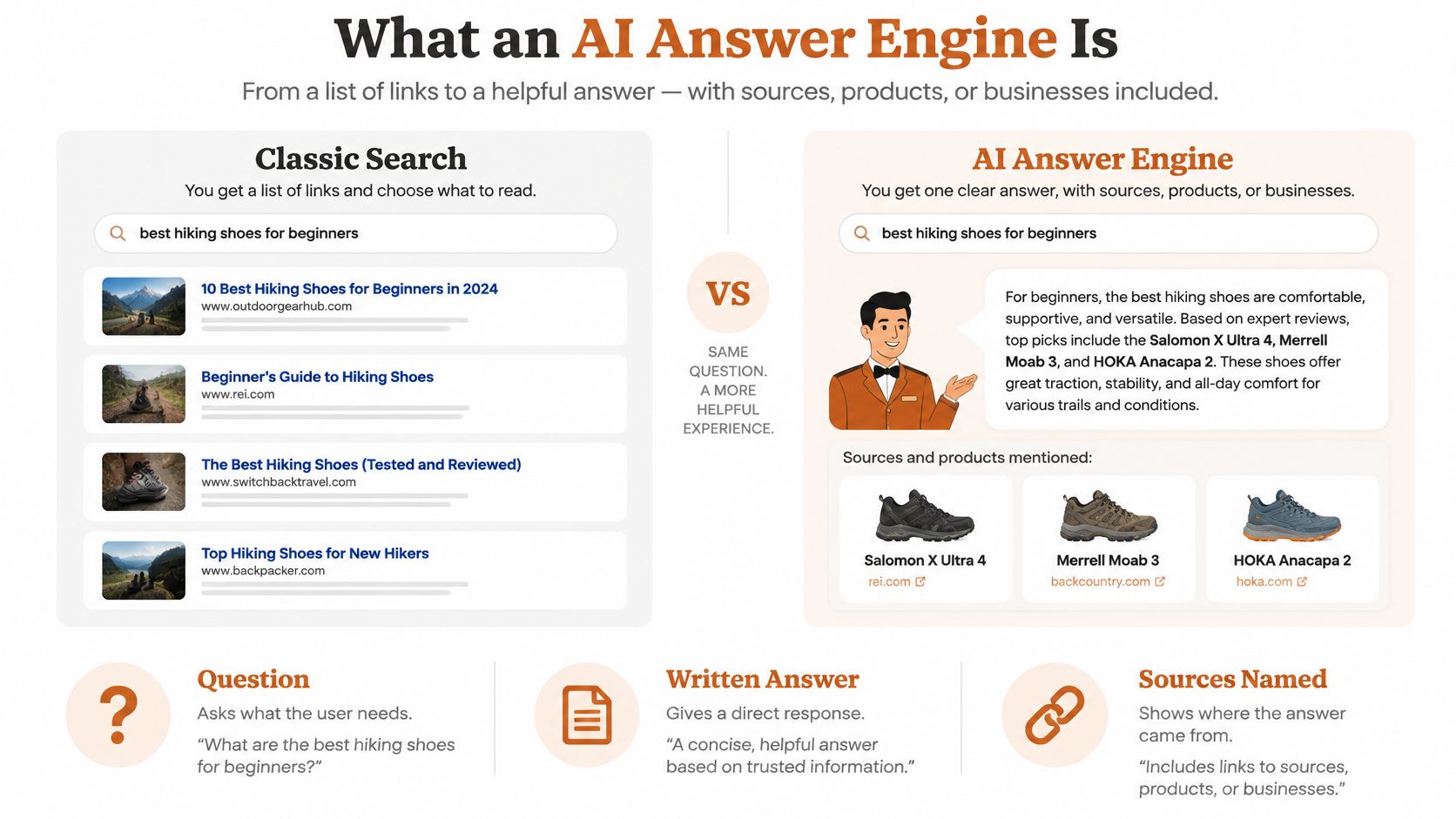
An AI answer engine is a system that takes a question and returns a written answer, often naming sources, products, or businesses, rather than presenting ranked links. The user receives an explanation or recommendation within the interface itself.
Think of the difference between a directory and a concierge. Classic search hands over a directory of potentially useful pages. An answer engine acts more like a concierge, recommending a shortlist and explaining which options match the request.
The commercial distinction: SEO earns a position on a list. Answer engine optimization earns a place inside the response where buyers consider their options.
That changes what useful visibility looks like. A facilities company wants the answer to connect its name with the correct service and region. A software provider wants its capabilities described accurately, not merely its homepage linked.
From Search Feature to Global Answer Layer
Google introduced AI Overviews at I/O in May 2024 for complex questions benefiting from summaries, comparisons, and multi-step explanations; by October 28, 2024, it was expanding to more than 100 countries and territories, according to Google’s AI Overviews expansion update. On May 20, 2025, Google reported availability in more than 200 countries and territories and over 40 languages, more than 1.5 billion monthly users, and more than 10% higher Google usage in the United States and India for query types displaying an Overview.
This is a globally distributed answer layer, not just an alternative search layout. Businesses need recognizable names, consistent descriptions, and evidence that remains understandable across markets.
The comparison below shows how the user’s question becomes a written response with named sources.
What Brands Need to Understand
Not every answer interface works the same way. Search summaries, conversational assistants, citation-led tools, and shopping assistants present different opportunities for inclusion.
The practical questions remain straightforward: how does the engine assemble its answer, which evidence does it use, and what can a publisher change so the business appears accurately? Understanding those mechanics turns AI visibility from an abstract ambition into a measurable marketing discipline.
The Four Kinds of AI Answer Engines
| Type | What it returns | Examples | Prize for a brand |
|---|---|---|---|
| Search-integrated overview | A synthesized summary above or beside links | Google AI Overviews, Google AI Mode | Named inside the summary |
| Standalone assistant | A conversational answer from stored knowledge plus live search | ChatGPT, Claude | Recommended in the written answer |
| Citation-first answer engine | An answer with sources the reader can open | Perplexity | Cited through a page that supports the claim |
| Task and shopping assistant | A shortlist inside a comparison or purchase task | Shopping flows in ChatGPT and retail assistants | Placed on the buyer’s shortlist |
These categories are a planning map, not rigid product boundaries. Google AI Mode extends beyond a compact overview, and a conversational assistant can also deliver a heavily sourced comparison. Classify the customer experience you’re testing, rather than assuming each product belongs in only one box.
Search Summaries and Conversational Recommendations
For a search-integrated overview, the prize is immediate inclusion in the synthesized response. A buyer asking about regional maintenance providers can encounter a company’s name before opening an individual result. The failure mode is omission from the summary, even when the company has a relevant page elsewhere on the results screen.
Standalone assistants support a longer exchange. In ChatGPT or Claude, a buyer can explain requirements, add constraints, and ask why a vendor belongs on the shortlist. Where search is enabled, the assistant can combine retrieved information with stored knowledge.
The prize is a recommendation within that conversation. The corresponding failure mode is misdescription: the assistant names the business but assigns the wrong specialty, audience, or capability.
Those are different problems. A missing company needs evidence that establishes relevance. A misdescribed company needs clearer facts about what it provides.
Source-Led Answers and Buying Tasks
Citation-first experiences make the relationship between an answer and its supporting pages particularly visible. In Perplexity, the reader can inspect sources alongside the response. The valuable outcome isn’t merely a citation marker, but a page that substantiates the sentence attached to it.
The failure mode is being cited for the wrong claim. A general company page, for example, doesn’t establish that a particular product supports a specific integration.
Task and shopping assistants organize information around a decision. Their output might compare products against a requirement or narrow a vendor list using buyer-supplied criteria. Here, the failure mode is dropping from the shortlist because specifications conflict across available sources.
- For communications teams: Prioritize accurate descriptions and supporting evidence.
- For product teams: Make comparison attributes explicit and consistent.
- For growth teams: Test the questions that precede an inquiry or purchase, not just broad category prompts.
At AnswerLion, we use AEO, or answer engine optimization. GEO, generative engine optimization, names the same work of helping systems understand and recommend a business. The label changes; the work doesn’t.
Under these different interfaces, the shared challenge is getting relevant evidence found, used, and represented correctly.
Diagnosing Retrieval, Citation, and Claim Accuracy
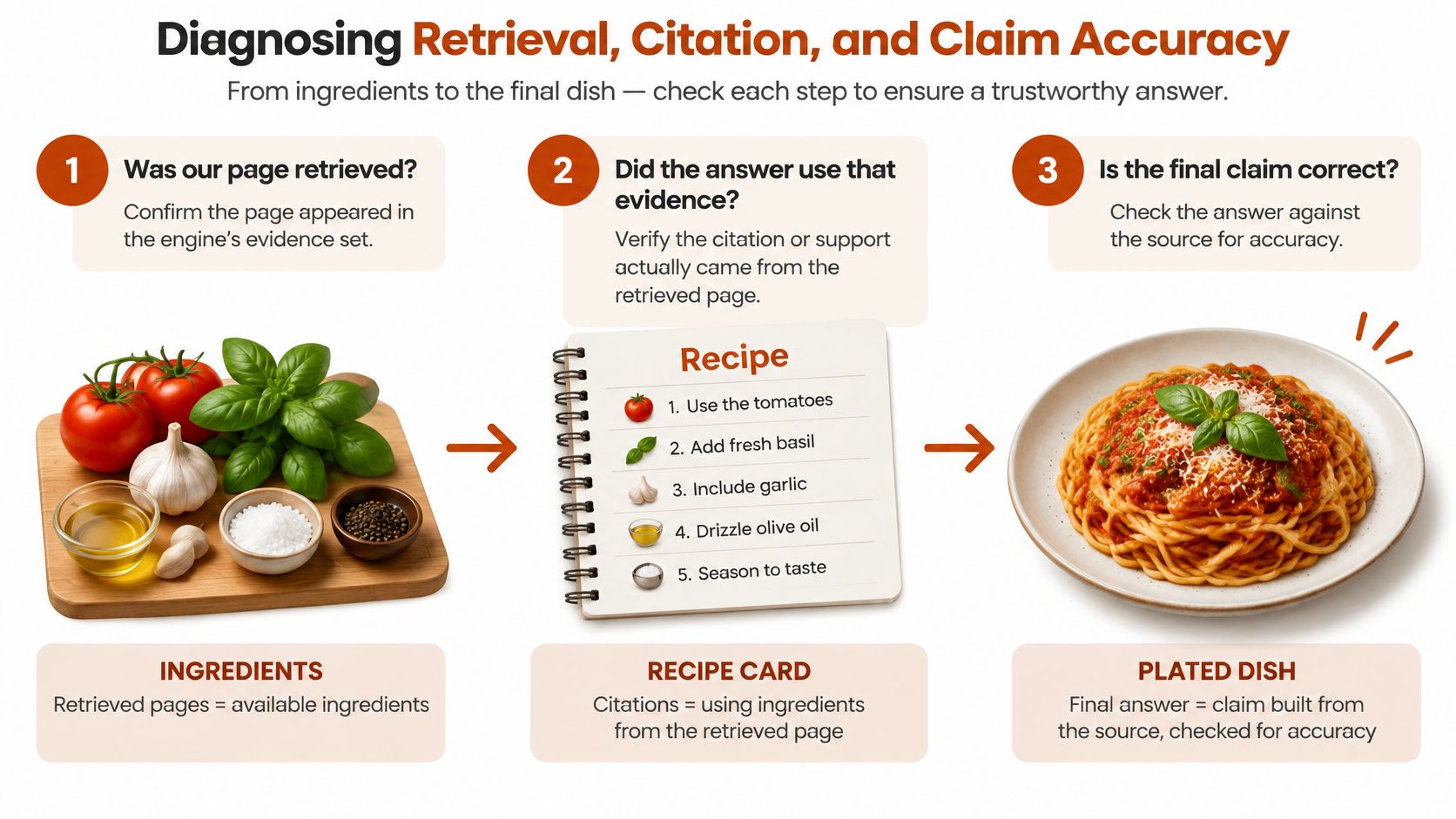
An answer engine’s output is the end of an assembly process. To improve it, distinguish what the system found from what it used and what it ultimately said.
A kitchen provides a useful model. Parametric knowledge is the pantry, information already stored in the model. Live retrieval is the market run, bringing in information from external sources. Grounding is the plating, assembling the response so its statements reflect the available evidence.
Google DeepMind’s evaluation framework separates stored knowledge, web-search performance, and grounding in supplied documents. For a marketing team, that means a correct description in one answer doesn’t establish that the engine can retrieve current supporting evidence for another.
Give Each Checkpoint Its Own Score
Start with the customer question, then evaluate these checkpoints independently:
- Retrieval: Was the relevant page present in the engine’s observable evidence set?
- Citation and evidence use: Did the answer use that page to support its response?
- Claim accuracy: Does the final statement match the source and the business’s current facts?
Record retrieval as unobserved when the interface doesn’t expose enough evidence to confirm it. A missing citation alone doesn’t establish that the page was never retrieved.
A 2026 systematic review of retrieval-augmented generation evaluation frameworks distinguishes context relevance, faithfulness, answer relevance, correctness, and citation quality, and describes a benchmark with retrieval recall@5 of 92% while citation groundedness ranged from 51% to 89%. Finding relevant information and faithfully using it are separate achievements.
This diagnostic sequence keeps each optimization tied to the stage it can improve.
For reporting, use distinct denominators. Measure retrieval coverage across tests where retrieval is observable, citation validity across citations inspected, and factual accuracy across claims audited. Don’t compress them into a single ranking-like score that hides the reason for improvement.
Connect Answer Quality to Commercial Outcomes
In Pew Research Center’s analysis of Google activity during March 2025, 58% of users encountered at least one search page containing an AI summary; traditional-result clicks occurred in 8% of visits with a summary versus 15% without, summary links received clicks in 1% of visits, and browsing sessions ended in 26% versus 16% of visits, respectively.
For a marketing director, the implication is practical: referral sessions don’t capture every valuable exposure. Track recommendation share across a fixed question set alongside branded search, direct inquiries, calls, and demo requests.
Keep those measures separate before looking for relationships. An increase in branded searches following stronger answer visibility is useful context, not a substitute for conversion evidence. Add a discovery-source field to lead forms or sales qualification notes so customers can explain where they encountered the business.
A useful dashboard answers both questions: Are buyers seeing us, and are they seeing an accurate reason to choose us?
Audit the Statement, Not Just the Citation
The Tow Center study reported by Nieman Lab tested eight AI search engines across 1,600 queries asking them to identify source articles from excerpts; engines returned incorrect source information in more than 60% of tests, and the strongest performer was wrong 37% of the time.
That was a source-identification test, not a universal error rate for brand recommendations. Its relevance is the distinction it exposes: an apparently authoritative attribution still needs verification.
For every audited answer, preserve the exact wording, cited URL, relevant source passage, and test context. Check individual claims about locations, product attributes, qualifications, and service boundaries.
| Outcome | What it means | Fix |
|---|---|---|
| Retrieved but not cited | The page was found and left unused | Clarify the opening answer and headings |
| Cited but unsupported | A source is named and the claim is not on that page | Align the sentence with a specific on-page fact |
| Cited and supported | The claim matches the cited page | Extend the same pattern to related questions |
| Omitted or wrong attribute | The business is missing or misdescribed | Correct the conflicting or missing fact |
An AI search visibility audit should preserve these distinctions. The resulting fix list becomes specific enough for content, technical, and brand teams to act on without guessing.
Where Buyers Already Use Answer Engines
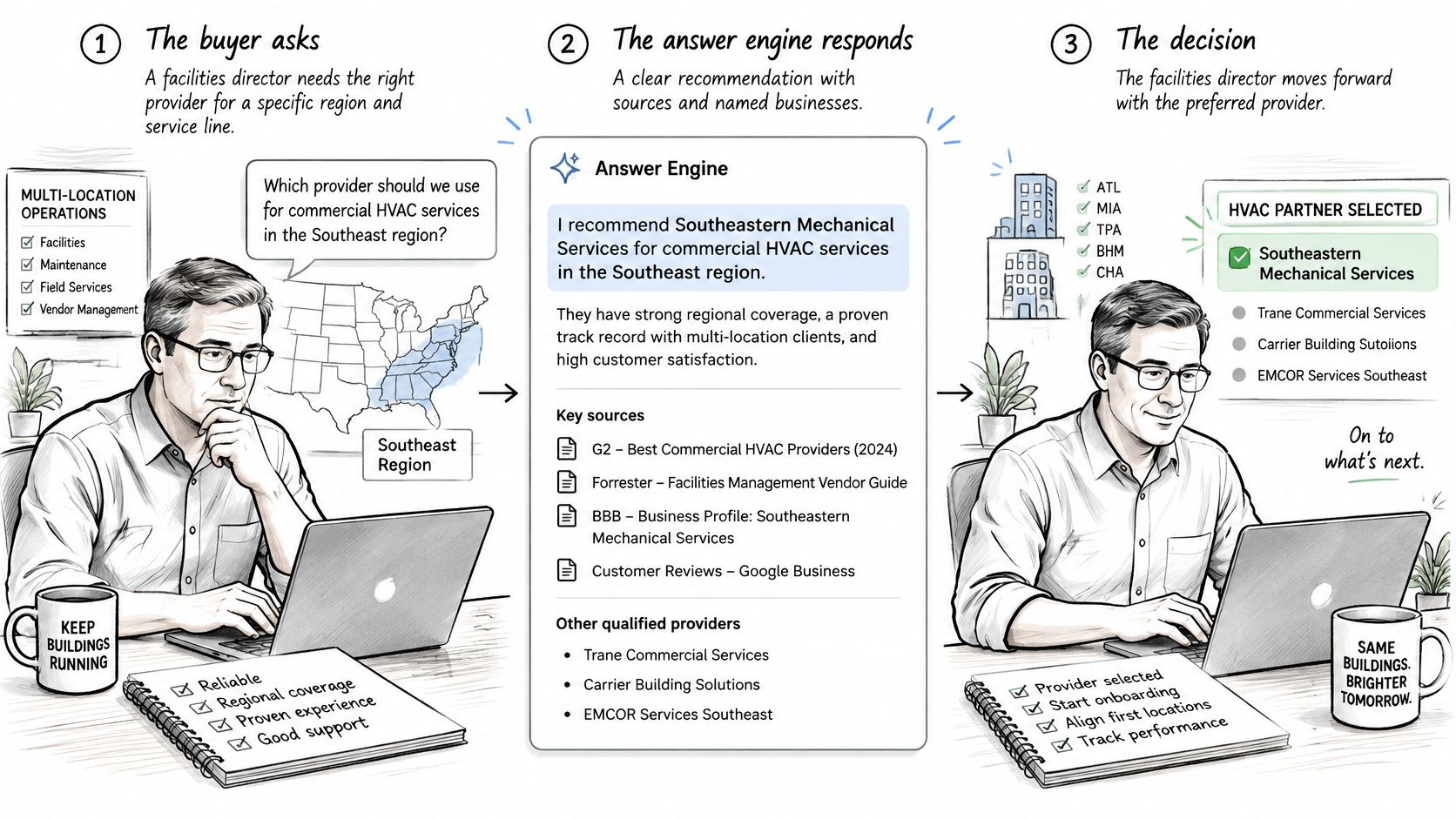
Consider a facilities director at a multi-location service company who asks an assistant to recommend a provider for a particular region and service line. In this hypothetical buying task, the assistant searches available pages and returns a shortlist of two to five businesses.
The decision flow connects the buyer’s requirement to the evidence behind the recommendation.
A Service Provider Earns the Right Introduction
The stronger result names a provider with the correct geography and specialty. The weaker result leaves a qualified company out or blends its description with a competitor’s category.
Visible win: An accurate business name, the correct service specialty, and a source that supports the recommendation.
A Publisher Becomes the Supporting Source
A publisher’s article answers a question directly on the search results page through an overview. In this scenario, the article with a clear, quotable finding receives attribution, while a competing article that buries its finding beneath a long introduction remains absent despite ranking.
Visible win: The correct publication name, the relevant subject expertise, and a source matching the summarized finding.
The video below provides another format for considering answer-led discovery.
A Product Brand Holds Its Shortlist Position
Say a product manager asks a shopping assistant to compare three brands against a required specification. The brand whose website, directory profile, and review pages agree gives the assistant a coherent basis for comparison. A conflicting specification can produce an uncertain or incorrect attribute and remove another brand from consideration.
Visible win: The right brand, the correct product capability, and a supporting page that matches the comparison.
These buying scenes sit within a broader pattern of adoption.
AI answer adoption in 2025
| Source | Measure | Value |
|---|---|---|
| Reuters Institute | People across six countries who saw an AI-generated search answer in the previous week | 54% |
| Comscore | Desktop users / mobile users who used AI assistant tools | 36% / 24%, respectively |
| Adobe | Generative-AI users who said they replaced traditional search with AI assistants | 36% |
| Bloomreach | Surveyed U.S. adults aged 18 to 50 who used general-purpose AI tools to help shop | 61% |
| Bain & Company | U.S. consumers using generative AI for product research and comparison | 30% to 45% |
These experiences repeat across ChatGPT, Claude, Perplexity, and Google AI Overviews. A single-engine spot check misses where the same buyer question receives a different recommendation or description.
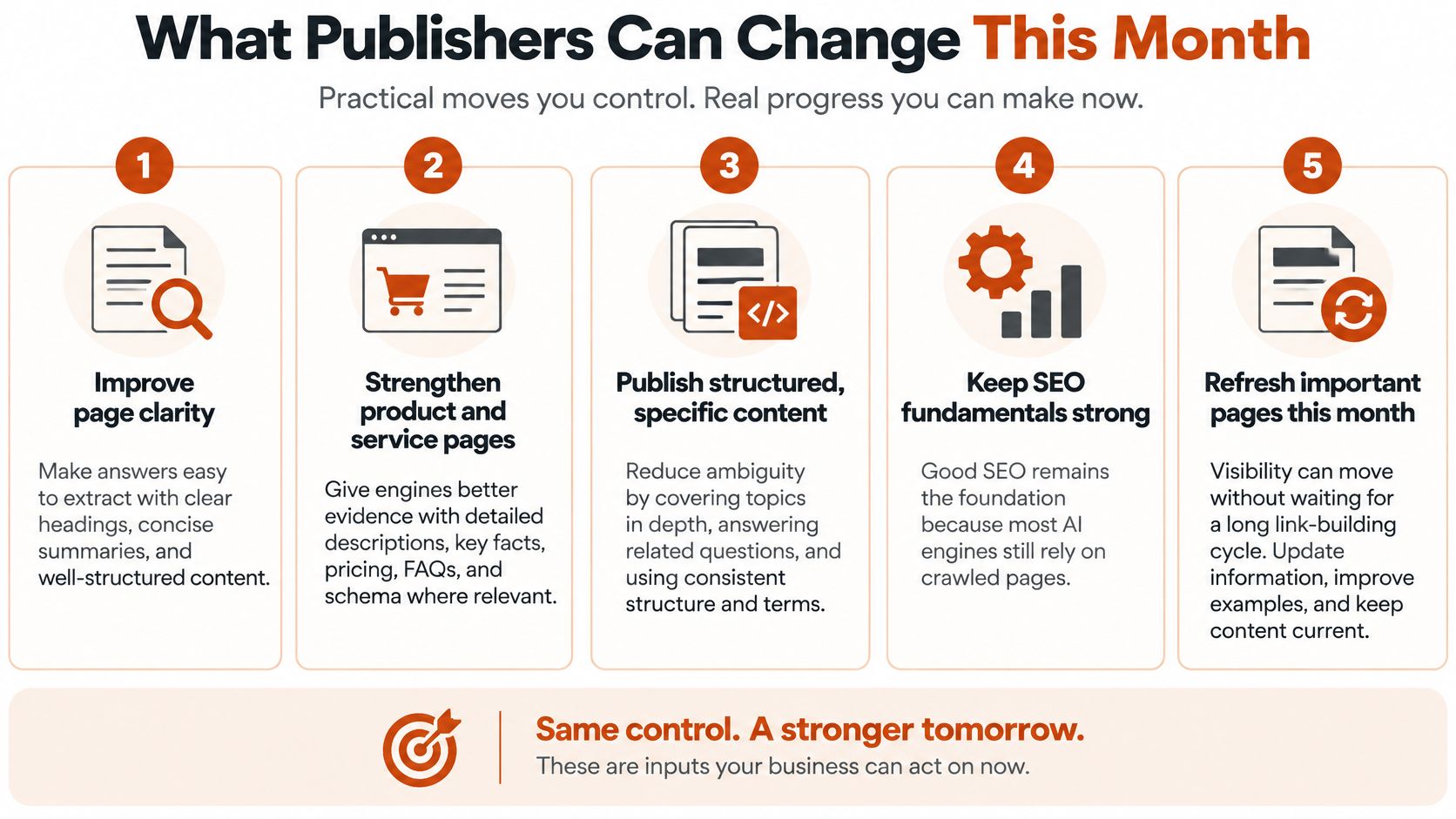
What Publishers Can Change This Month
Start with inputs your team already controls. Page clarity, accessible evidence, and accurate business profiles can move forward without waiting for a long link-building cycle.
At AnswerLion, we treat good SEO as the foundation for AEO, because most AI engines still draw on web search results and well-structured, credible pages. The work strengthens those pages rather than replacing established search fundamentals.
Make the Evidence Clear and Accessible
-
Put the direct answer first. Choose the page that owns the customer’s question and answer it in its opening sentence. Then add details a model can quote: the service, location, intended customer, and relevant boundaries. A regional service page should identify what the team does and where it operates, not open with a generic statement about commitment to excellence.
-
Add accurate, accessible structured data. Use Organization, Service, FAQ, and Article markup where each type matches the visible content. Google’s structured-data policies require relevant pages to remain accessible rather than blocked by robots.txt, noindex directives, or other access controls. Validate the markup, test the page with URL Inspection, request a recrawl after validation, and submit a sitemap. Treat schema as a description of published facts, not a place to introduce unsupported capabilities.
The checklist below groups these improvements into practical publishing priorities.
Control Discovery and Resolve Conflicting Facts
-
Separate search visibility from training access. The crawler documentation identifies OAI-SearchBot as the crawler used to surface websites in ChatGPT search, while GPTBot governs model-training use; those controls operate independently. Allowing OAI-SearchBot while disallowing GPTBot is a valid choice. Sites opted out of OAI-SearchBot won’t appear in ChatGPT search answers, although they may still appear as navigational links. Have your technical owner review search access separately from your organization’s training policy.
-
Make business facts agree across the web. Compare the website with directory listings and review profiles. Reconcile the business name, offer, locations, and product specifications, then assign an owner to maintain them. If a service is available only in certain markets, state that boundary consistently instead of leaving the assistant to infer it.
Practical rule: Publish one clear version of each important fact, then make every supporting profile agree with it.
Use the AEO best practices guide to organize implementation around your priority pages. The outcome is a stable, quotable description that engines can pick up on the next crawl, supported by facts your team can verify.
Confirm Your Baseline Before You Invest
Record how engines answer your customers’ real questions before rewriting pages or adding markup. That baseline identifies the gap worth fixing first, whether it’s omission, a wrong attribute, or a citation that doesn’t match the page.
Start with questions collected from sales calls, customer support, procurement conversations, and on-site search. Include the constraints buyers mention, such as region, use case, compatibility, or service coverage. A broad category question alone won’t reveal whether an engine understands your strongest buying proposition.
Preserve a Decision-Ready Record
For each question, capture the engine, date, response, named businesses, supporting sources, and exact claims about your company. Repeat tests under comparable conditions and retain changes in wording, not just changes in appearance.
- For the marketing director: Identify which commercially important questions exclude the business.
- For the content owner: Preserve the missing or inaccurate claim that needs a better on-page answer.
- For the technical team: Separate access problems from evidence and wording problems.
- For leadership: Show the initial condition, the action taken, and the observed change.
This makes LLM visibility tracking useful as a decision process rather than a collection of screenshots. Prioritize questions close to a buying decision and claims central to qualification.
Start With the Questions Buyers Already Ask
AnswerLion is an answer engine optimization agency that helps businesses get cited and recommended by ChatGPT, Perplexity, Claude, and Google AI Overviews. Every engagement starts with a baseline of how AI engines answer the customer’s questions today.
To get started, email hello@answerlion.com with your website and a few questions customers ask. We’ll tell you where the business stands and what we would change first.
The payoff follows a practical sequence. Engines gain a consistent description to quote, the business begins appearing for targeted questions, and visibility extends to related questions as the same facts stay aligned across the website and third-party profiles.
We re-run the same customer questions across major engines on a regular schedule, recording whether the business is named, how it’s described, and who else is cited. That gives your team a continuing basis for choosing the next improvement.
Send your questions this week so the first fixes address the answers buyers already receive. You’ll begin with a clear decision: what to correct, which page or profile owns the evidence, and how to evaluate the change.
AnswerLion helps businesses turn AI answer engine visibility into accurate, supported recommendations through baseline audits, content improvements, technical setup, and ongoing monitoring. Visit AnswerLion and bring your website and customer questions so we can identify where your business stands and what to improve first.