 AnswerLion
how to appear in google ai overviews
How to Appear in Google AI Overviews in 2026
Learn how to appear in Google AI Overviews with answer-first pages, schema, third-party citations, and a monthly question audit.
Published · Updated · By AnswerLion

88% of Google AI summaries cited at least three sources, according to Pew Research Center’s analysis of U.S. browsing activity. That changes the objective. You’re not trying to own an entire answer. You’re trying to become a credible source Google can include alongside other trusted references.
For marketing directors asking how to appear in Google AI Overviews, the strongest approach combines a quotable page, independent corroboration, and a fixed question log. Publish the answer buyers need, make your public business facts agree, and measure whether Google cites and describes you correctly. More AI-targeted copy isn’t the strategy. A clear, verifiable answer is.
Table of Contents
- What a Citation in an AI Overview Is Worth
- Write Questions and Answer-First Pages
- Add Schema and Open the Site to Crawlers
- Earn the Outside Sources Google Already Trusts
- Track the Same Questions Every Month
What a Citation in an AI Overview Is Worth
A buyer sees a generated answer, supporting source links, and conventional organic results beneath it. Your business can earn visibility in either place, but those appearances serve different purposes. A citation puts your information inside the explanation; an organic listing offers another route to your website.
Pew’s March 2025 panel included 900 U.S. adults, of whom 58% conducted at least one Google search that produced an AI summary. In that same analysis, users clicked conventional results on 8% of visits with a summary, compared with 15% without one, while links inside summaries received clicks on 1% of visits.
Those figures describe observed browsing behavior, not the revenue value of an individual citation. Use them to reset expectations before leadership evaluates an AEO program against a traffic-only target.
AI Overview visibility versus a blue link
The following leadership brief draws its browsing figures from the Pew analysis introduced above.
| Measure | Figure | What to do with it |
|---|---|---|
| US adults with an AI summary in March 2025 | 58% of 900 adults | Treat Overviews as a standard research surface |
| Click on a conventional result | 8% of visits with a summary vs 15% without | Plan content for fewer blue-link clicks on informational queries |
| Click on a link inside the summary | 1% of visits | Value the mention and measure branded and assisted demand |
| Summaries citing three or more sources | 88%, and only 1% cite a single source | Aim to be one trusted source among several |
| Separate AI submission required | None; crawlable helpful pages are eligible | Spend effort on answers and corroboration, not a special filing |
| Wikipedia, YouTube, and Reddit as cited sources | Together, 15% of AI-summary sources | Evaluate relevant public references beyond your website |
| Government websites as sources | 6% of AI-summary sources vs 2% in standard results | Support explanations with authoritative primary evidence |
Define the win before funding the work
A correct citation is a useful visibility outcome, not proof of a sale. A buyer might remember your company, search for it later, or open the source to verify a claim. Record those outcomes separately rather than assigning every subsequent branded visit to AI exposure.
The source mix also gives you a practical direction. Your website, profiles, and public references should describe the same offer. Don’t publish a service page aimed at enterprise buyers while prominent directories still describe a small-business-only product.
A citation is a share of a multi-source answer. Earn that share with a useful passage and a consistent public record.
AEO can show signals faster than SEO because fewer businesses compete deliberately for AI visibility, engines can refresh their answers before conventional rankings move, and businesses control direct answers, structured data, and listings. Use that opportunity to improve a specific commercial description, not to chase appearances on unrelated questions.
Set the initial definition of success narrowly: the right page, cited for the right question, with an accurate description. Eligibility starts with accessible, helpful content, and a useful passage can contribute without holding the leading organic position. The commercial assessment comes from connecting that visibility to qualified demand.
Write Questions and Answer-First Pages
A buyer’s question should shape the page that answers it. A broad article about an industry rarely explains whether a service fits a specific need, what the offer includes, or what evidence supports it. Build pages around those decisions, then make the answer clear before adding detail.
Assign one person to maintain the question list and another to approve product or service facts. Content teams need accurate information about scope and delivery, not guesswork based on old sales material.
Build a question-to-page workflow
-
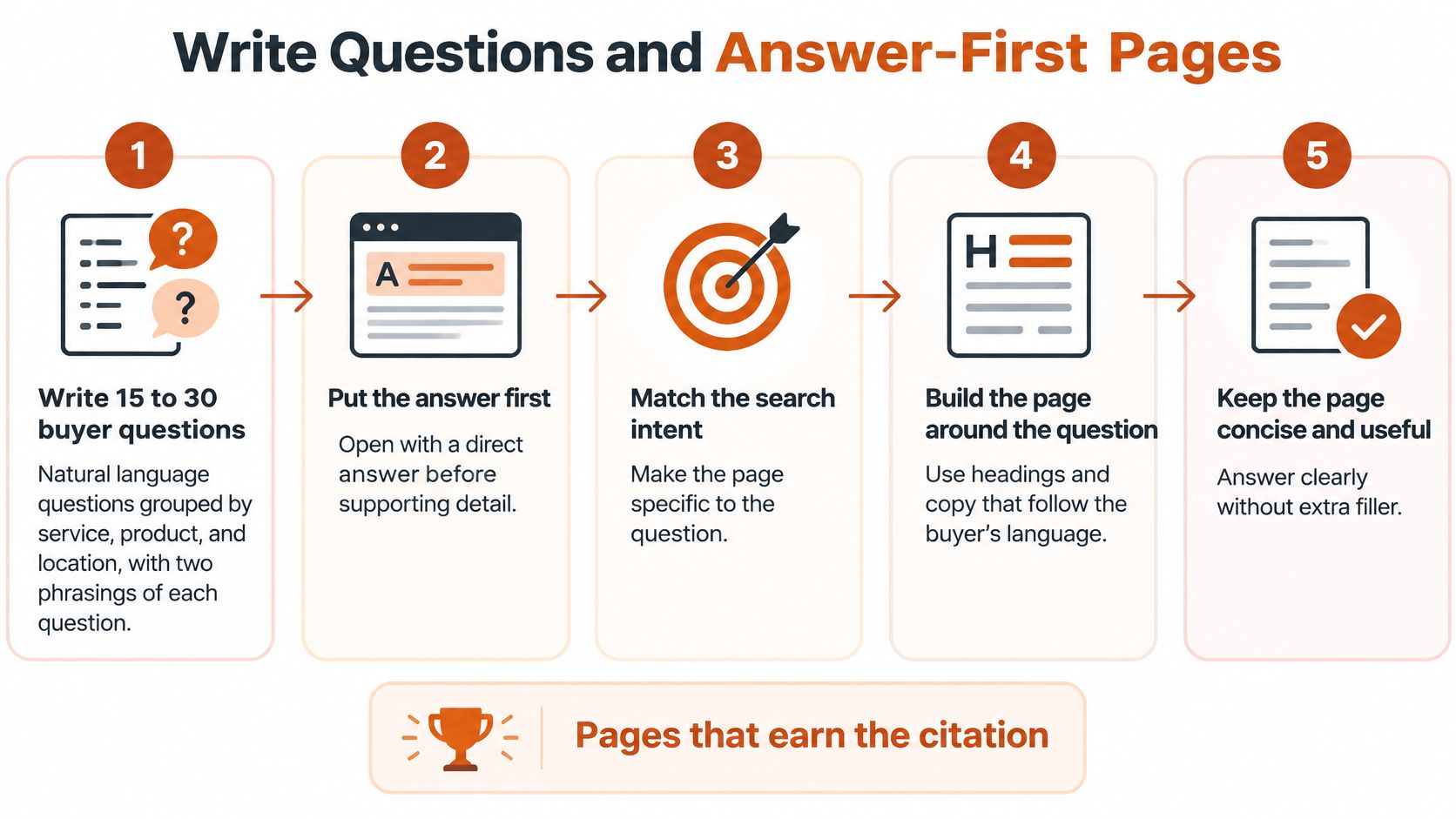
Write 15 to 30 buyer questions. Group them by service, product, and location, then create two natural-language phrasings for each. Pull wording from sales calls, customer support tickets, Search Console queries, and internal site search.
For a commercial HVAC company, useful questions include whether it services occupied office buildings, what a maintenance agreement covers, and which locations its technicians serve. Prioritize questions that distinguish a qualified prospect from an unsuitable enquiry.
-
Test every phrasing in Google. Record whether an Overview appears and which pages it cites. Keep each query’s wording intact so your team can repeat the check.
A Washington University study of 55,393 searches on trending topics found AI Overviews on 13.7% of queries, with frequency changing sharply by wording, according to Washington University’s account of the study. Use your own checks to choose which questions deserve attention. The priority is a real buyer need, not a phrase that happens to trigger an Overview.
-
Map each question to its best existing URL. Open the page with a direct answer, then explain who the offer serves, what it includes, and what supports the claim. Several related questions can share a page. Avoid competing URLs for minor wording differences.
-
Write a self-contained answer passage. Name the service or product, state the relevant qualification, and replace pronouns that rely on surrounding text. The passage should make sense if an AI assistant quotes it alone.
Surfer’s analysis of 405,576 English-language AI Overviews found an average length of 157 words, approximately five cited sources, and 99% shorter than 328 words. It also found that 52% of cited sources appeared in the traditional organic top 10. These findings support concise answer passages backed by fuller explanation. Keep the page useful as a whole rather than forcing it into a fixed word count.
-
Add a short, visible FAQ. Answer genuine follow-up questions about eligibility, scope, delivery, or location. Keep its facts consistent with the main answer. Repeat information when it addresses a different buyer concern, not just to repeat a keyword.
-
Maintain conventional SEO. Keep descriptive titles, sensible internal links, and a clear place in the site hierarchy. If a URL changes, manage the redirect and update internal references. Preserve an established page instead of replacing it with an AI-branded version.
The practical goal is a page that answers a buyer’s question directly and gives other sources something specific to confirm. A citation is one share of a multi-source answer. Pair a quotable passage with outside corroboration, and keep a fixed question log so you can see which answers earn visibility.
Publish the highest-value answer first
If a buyer asks whether your software supports separate permissions for regional teams, lead with the actual permission model, the relevant plan or configuration, and any meaningful limitation. Put screenshots, setup instructions, and longer comparisons after that answer.
Good SEO is a foundation for AEO because most AI engines still draw on web search results and well-structured, credible pages. Publish the highest-value question answered properly first. A focused, accurate page gives engines a clear answer to retrieve and gives outside sources a specific claim to corroborate.
Add Schema and Open the Site to Crawlers
Technical work should make your published facts easy to retrieve and interpret. It shouldn’t introduce a second, more ambitious version of your offer that exists only in markup.
Google’s guidance for AI features says websites don’t need special AI-only markup or a separate submission process. It also explains that these features may perform related searches and combine supporting information from multiple pages. Schema clarifies your facts. It isn’t a ticket into an Overview.
Set up the business entity and page facts
-
Start with Organization markup on the homepage. Include the legal name, logo, canonical website URL, and
sameAsreferences to official profiles. Distinguish the legal entity from a trading name where necessary, and keep both understandable to visitors. -
Describe the offer on its owning page. Use Service markup for a service and Product markup for a product or appropriate plan page. Select supported properties that accurately describe the visible offer. Don’t force every marketing sentence into a structured-data field.
-
Mark up only visible FAQs. The question and answer must appear on the page, with the same meaning as the markup. Our FAQ schema example gives your implementation team a practical reference. Treat FAQ markup as semantic description, not a promise of a search enhancement.
-
Identify explanatory content with Article markup. Match the headline, author, and publication or modification date to what readers can see. Update the modification date when the content materially changes, not whenever the template rebuilds.
-
Use LocalBusiness markup for a genuine location entity. Put the correct name, address, and location-specific services on the relevant page. A service-area page shouldn’t imply a staffed office that doesn’t exist.
-
Check access and delivery. Review robots.txt for Googlebot and the other AI search crawlers you intend to welcome. Submit a clean XML sitemap, expose essential answers in server-rendered HTML, and remove accidental indexing restrictions.
Schema to add for AI Overview passages
| Schema type | Place it on | Fact it should match |
|---|---|---|
| Organization | Homepage | Legal name, logo, URL, and official profiles |
| Service | Core service page | Offer name, audience, and what is included |
| Product | Product or plan page | Product name and the distinguishing specifics |
| FAQ | Any page with visible questions | The same questions and answers printed on the page |
| Article | Explainer or guide | Headline, author, and date |
| LocalBusiness | Location or service-area page | Name, address, and the services at that location |
Validate the JSON-LD with Schema.org’s validator and use Google’s Rich Results Test for supported search features. A valid result confirms implementation details, not citation selection.
Verify the rendered answer
Use Search Console’s URL Inspection tool to check the answer page. Confirm that Google can retrieve the canonical URL, see the substantive text, and access it without a login, consent interaction, or client-side dependency.
Publish an llms.txt file as a supplementary business summary if it’s part of your wider AEO setup. State who the business is, what it offers, and which pages explain it best. It isn’t a Google eligibility requirement and doesn’t replace indexing controls or an XML sitemap.
Finish with a spot check: one priority question, its owning page, and matching facts across visible HTML, schema, and the business summary. Assign any discrepancy to a named owner before deployment.
Earn the Outside Sources Google Already Trusts
90% of surveyed B2B buyers said they clicked cited sources to fact-check information, and 72% encountered AI Overviews during research, according to the buyer study covered by Search Engine Journal. That makes the supporting source part of the buying experience, not merely a technical citation target.
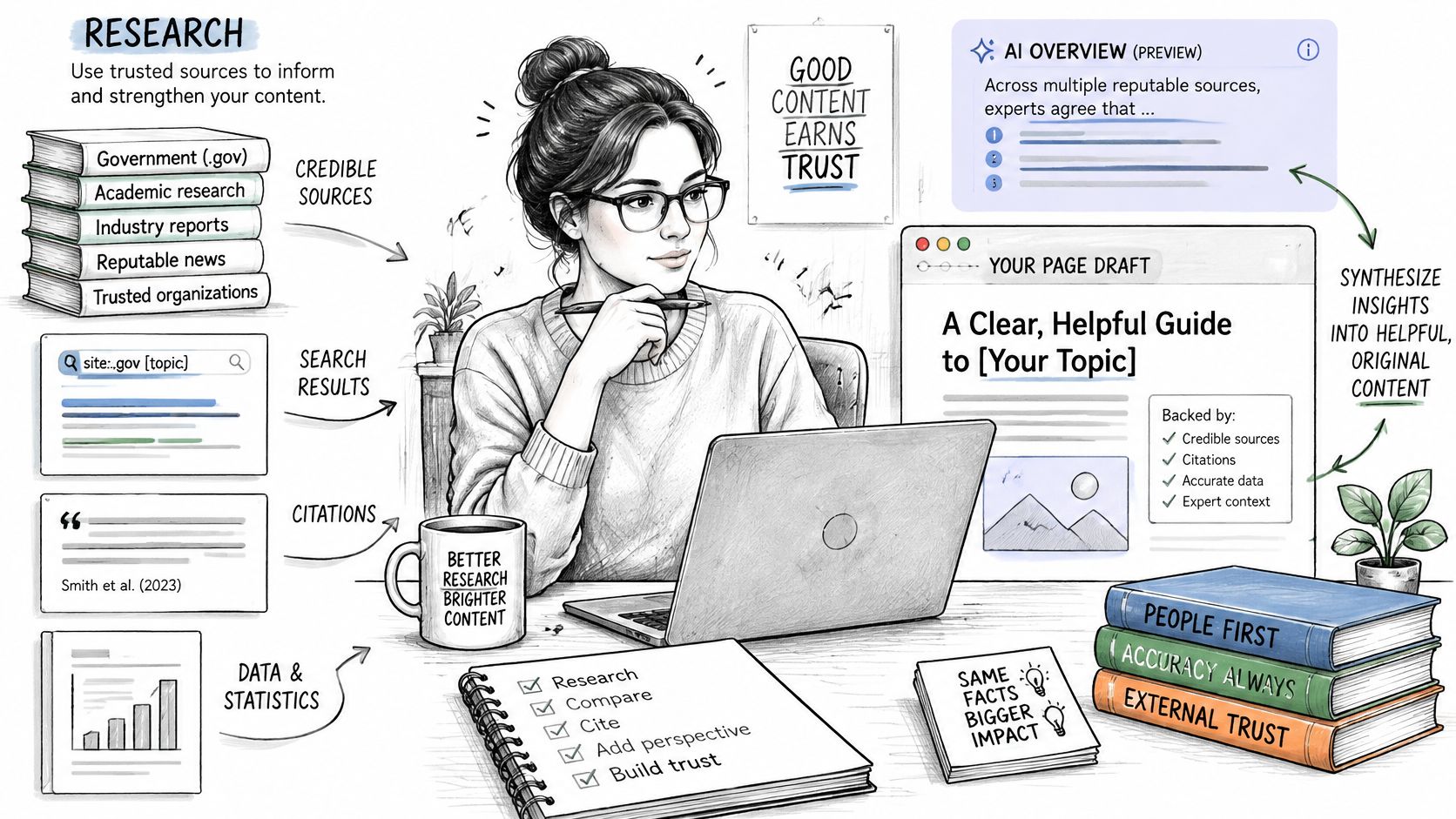
Give outside corroboration its own owner and workstream. Your website can explain the offer, but independent publications, directories, and sector bodies provide places where buyers can verify it.
Build the public record around information a buyer would check.
Correct the record before expanding it
-
Inventory existing mentions. Search the company name, trading names, locations, and major products. Build a spreadsheet of directories, review sites, partner pages, trade publications, and association profiles. Record the owner, current description, correction route, and status.
-
Resolve conflicting facts. Start with names, service scope, locations, and product availability. Preserve legitimate differences between offices or business units. Consistency means accurate alignment, not copying identical promotional text everywhere.
-
Claim relevant missing profiles. Choose platforms buyers use in the markets you serve. Complete the substantive fields and attach the appropriate service or location URL. Avoid directories whose only apparent purpose is selling listings.
-
Earn explanatory mentions. Offer a trade editor a useful technical explanation, a documented process, or a qualified subject-matter expert. Seek coverage that helps answer a buyer question. A passing brand mention with no relevant context provides less for a reader to verify.
-
Recheck both sides. Compare the published third-party description with the owning website page. Correct stale first-party copy too. Keep a record of corrections so future campaigns don’t reintroduce old wording.
Our guidance on AI brand mentions treats those references as part of a coherent public description. The objective isn’t to manufacture agreement. It’s to make accurate information available wherever buyers investigate.
Fix the multi-location conflict
Say a multi-location firm’s website describes commercial HVAC maintenance, but a prominent directory still categorizes its branches as residential repair providers. A buyer checking the company now encounters incompatible descriptions.
Correct the directory category and branch descriptions, then verify each location page’s actual service coverage. Don’t label every branch commercial if some still handle residential work. The useful outcome is a precise account of which team does what, and where.
A citation can be an outcome of established authority rather than a direct reward for an FAQ or schema change. Compare visibility against the strength of the company’s wider public record instead of crediting the most recent on-page edit automatically.
Use the same buyer-focused standard when deciding which external references to pursue.
Leave the workstream with a corrected profile list and two earned-mention targets. For example, choose a relevant trade publication accepting expert contributions and a sector association maintaining supplier guidance. Name the editor or profile owner, the buyer question you can help answer, and the next outreach action.
Track the Same Questions Every Month
A fixed question log makes AEO manageable. Without it, your team can mistake a different query, location, or search context for an improvement.
At AnswerLion, we re-run the same customer questions across major AI engines on a regular schedule, recording whether the business is named, how it’s described, and who else is cited. Keep the Google AI Overview record separate so movement in another engine doesn’t obscure your Google performance.
Keep the evidence reproducible
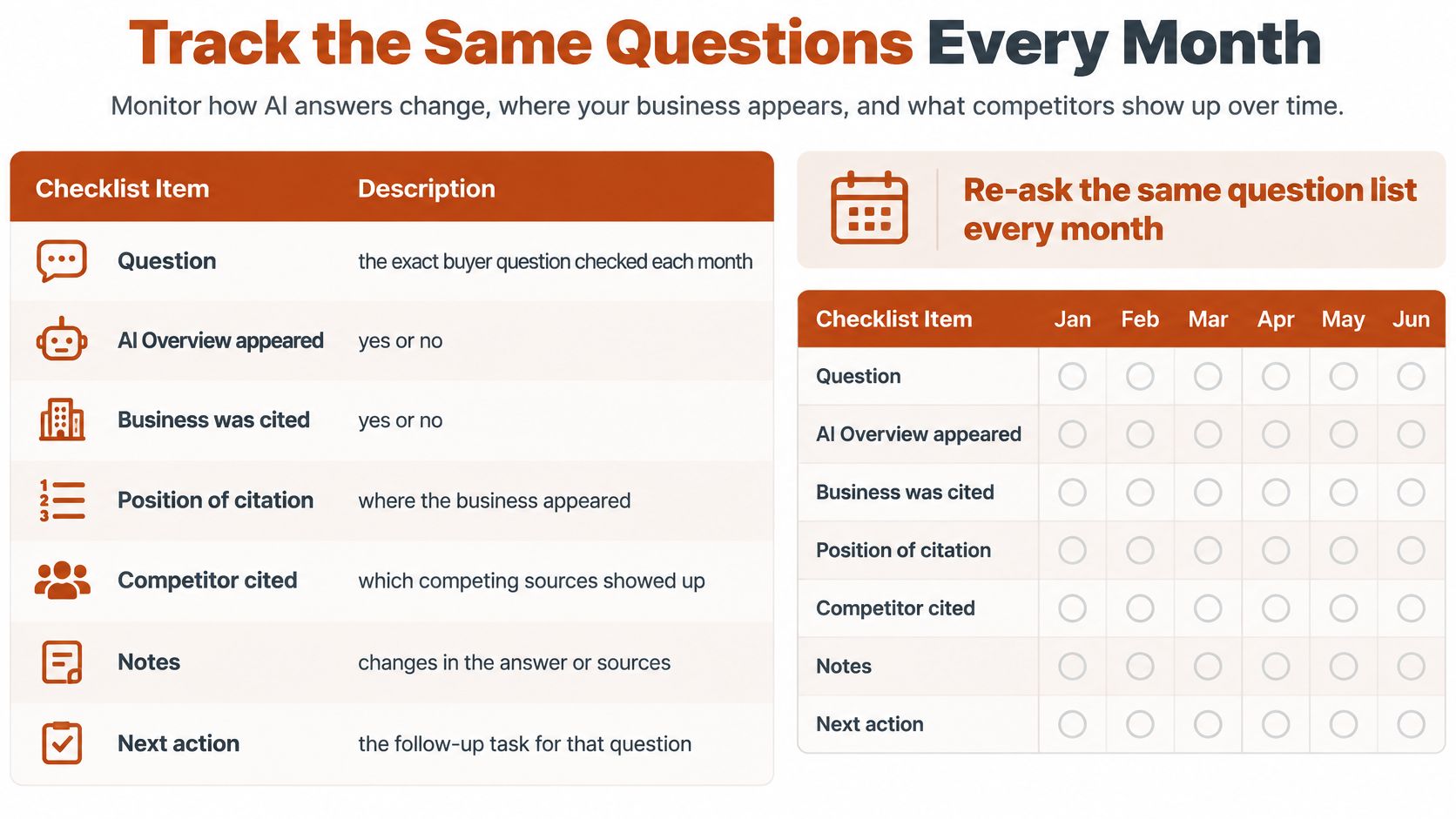
Record these seven fields for every priority question:
- Question: The exact wording checked.
- Overview appeared: Whether Google displayed an AI Overview.
- Business named: Whether the answer identified your company.
- Cited URL: The actual supporting page, not just the domain.
- Description used: The wording applied to your company or offer.
- Other brands cited: Competitors and other supporting sources.
- Organic presence: Whether the owning page still appears in conventional results.
Add the check date, market, and device as test context. Preserve a screenshot when an answer changes materially, and distinguish a brand mention from a linked citation.
Our LLM visibility tracking approach uses a recurring baseline rather than isolated screenshots. Keep the original question set stable; add new variants in a separate group so expansion doesn’t distort the comparison.
The usual progression is accurate description, targeted inclusion, then broader visibility as authority builds. A wrong description can correct after a recrawl, often within weeks. Independent authority takes longer to establish, so report those workstreams separately.
Use a monthly checklist to turn observations into assigned actions.
Read citations beside commercial demand
Ahrefs’ analysis of 300,000 keywords found AI Overviews correlated with a 34.5% lower average click-through rate for the top-ranking page compared with similar informational queries without an Overview. That’s a reason to measure more than organic clicks, not a reason to stop measuring them.
A separate analysis summarized alongside these findings examined 3,119 informational queries across 42 organizations, reporting a 61% organic CTR decline where Overviews appeared and 35% more organic clicks for cited sites than non-cited sites. That association doesn’t establish that citation caused the difference. Stronger brands and stronger pages can influence both outcomes.
Report qualified visits, branded search, enquiries, conversions, and assisted revenue beside the citation log. Label increases in branded demand as supporting evidence, not proven AI attribution.
Monthly citation signals and the next move
| Signal | What you see | Next move |
|---|---|---|
| Named in the answer | Brand or URL is among the cited sources | Extend the same pattern to a related question |
| Described incorrectly | Old offer, wrong location, or a blended competitor line | Correct the conflicting page or profile first |
| Overview cites others only | Competitors are named on a priority question | Strengthen the answer passage and one third-party mention |
| Overview does not appear | Short or navigational wording | Test a longer natural-language variant |
| Cited while visits shift | Organic clicks ease and branded demand rises | Report assisted demand and keep the citation |
Give leadership a one-page monthly note: what Google says, what changed, and the next fix. Include the business outcome attached to that fix, such as better-qualified enquiries for a service or accurate coverage for a new location. Your program should produce decisions, not a gallery of favorable answers.
AnswerLion offers baseline AEO audits, answer-first content, technical implementation, authority work, and recurring visibility reporting to help businesses earn relevant AI citations. Visit AnswerLion to start with your priority buyer questions, establish how Google describes your business today, and identify the first changes worth making.