 AnswerLion
ai search optimization
AI Search Optimization: Get Named in Answers
AI search optimization gets your business named in ChatGPT, Google AI, Claude, and Perplexity answers. See how it differs from SEO and what to measure.
Published · Updated · By AnswerLion

In a March 2025 study, people clicked a link inside a Google AI summary in just 1% of visits where a summary appeared, according to Pew Research Center’s analysis of browsing data. For businesses, that changes the visibility prize: it’s no longer enough to rank among search results. The business must also be understood, named, and recommended in the answer people read.
Consider someone choosing a local contractor. An assistant may summarize what the contractor does, cite a service page, and still recommend a competitor. Those are three different outcomes: accurate description, citation, and recommendation. A sound AI search program measures all three, then connects them to customer actions.
Table of Contents
- What AI Search Optimization Means Now
- How AI Search Optimization Differs from SEO
- Five Levers That Earn a Place in the Answer
- How Priority Questions Look in Practice
- Citation Recommendation and Commercial Impact
- Why Engines Skip or Misstate a Business
- Start from a Baseline of Customer Questions
What AI Search Optimization Means Now
Pew Research Center found that 58% of 900 U.S. adults had conducted at least one Google search that produced an AI-generated summary. In the same study, users who encountered a summary clicked a traditional result on 8% of visits, compared with 15% when no summary appeared. They clicked a link inside the summary on 1% of visits and ended their browsing session on 26% of pages with a summary, versus 16% of pages with traditional results alone, according to Pew’s study of Google search behavior.
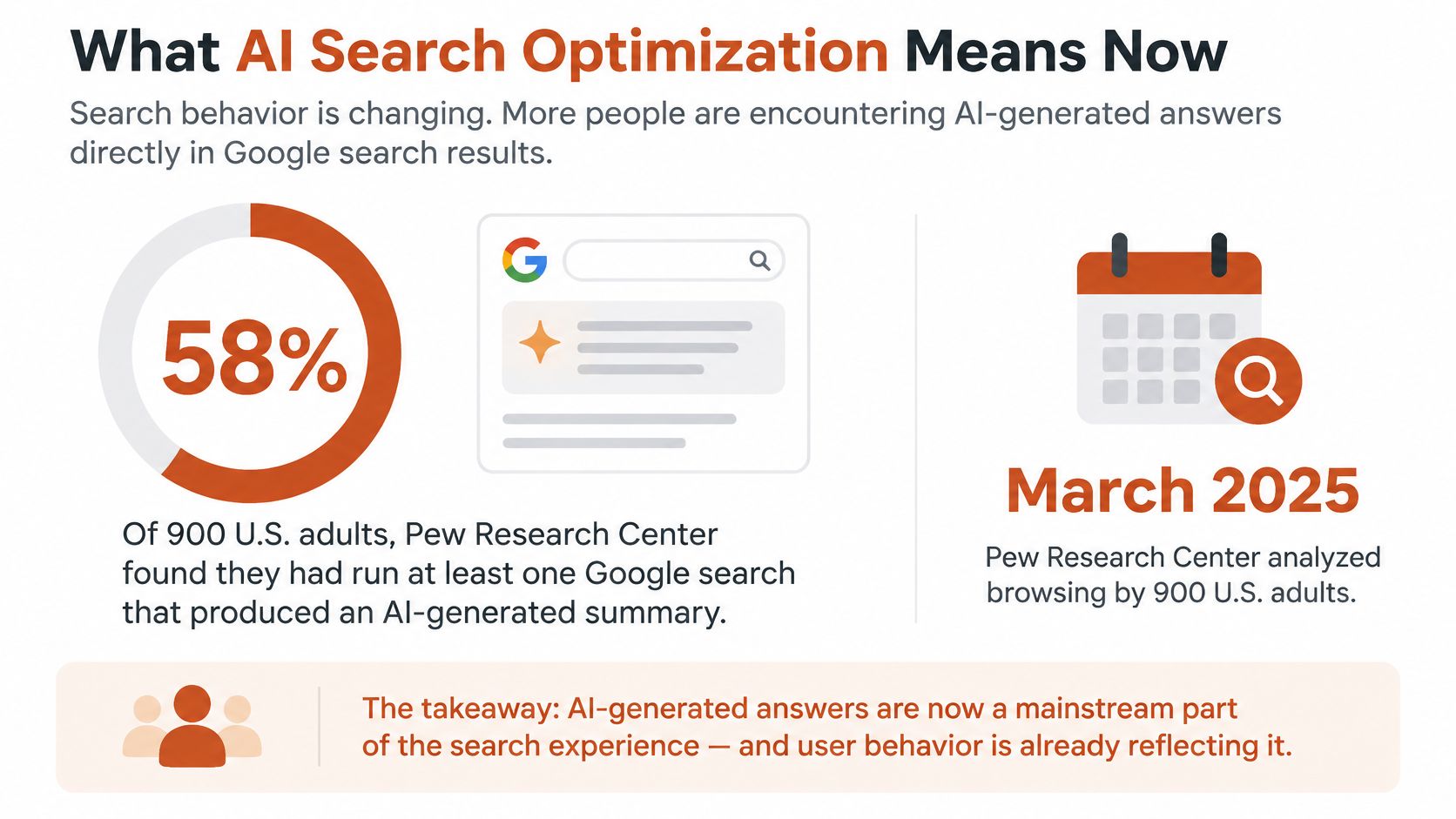
That shift matters when a buyer asks an assistant to compare providers. A business can have a relevant page and still miss the answer if the system doesn’t select it as a source or doesn’t identify it as a suitable choice. Traditional search visibility and answer visibility are related, but they aren’t interchangeable.
AI search optimization is the work of structuring a website and its wider online presence so AI assistants can understand the business and name it when people ask questions. AnswerLion calls this answer engine optimization (AEO); generative engine optimization (GEO) is the research term for the same work.
Pew found that about 18% of Google searches in its study produced an AI summary, and 88% of those summaries cited at least three sources. A business therefore needs more than a rank: it needs useful pages that can be cited alongside other sources, clear facts that can be summarized accurately, and evidence that supports a recommendation.
The practical goal is to move from being merely discoverable to being included among the businesses the answer presents as good choices. The distinction becomes clearer when you compare ranking with recommendation, work through the changes that make a business quotable, and track outcomes on a consistent question set.
How AI Search Optimization Differs from SEO
A buyer who asks an assistant for a shortlist does not see ten blue links. They see a paragraph that names a few businesses and explains the choice. SEO earns a position in a list of links; AI search optimization earns a place inside that paragraph.
That does not make SEO obsolete. Google says pages must be indexed and eligible to appear with a normal search snippet before they can qualify as supporting links in AI Overviews or AI Mode, and that no special schema markup or AI-specific text file is required. Google’s guidance on AI features in Search makes the relationship clear: sound technical SEO is the foundation, while answer-level work gives engines clear facts to use.
| Criterion | Traditional SEO | AI search optimization |
|---|---|---|
| Objective | A high position in a list of links | Being named inside the generated answer |
| Unit of competition | Every page targeting the query | The handful of businesses an assistant will mention |
| Primary inputs | Content, technical quality, and links | Direct answers, structured data, and consistent listings |
| Time to a visible signal | Months of compounding rankings | Often weeks after engines re-crawl; refresh cycles can move faster than rankings |
| Success measure | Rank and clicks from the results page | Accurate description, citation, and recommendation |
The timing row compares different signals, not equal outcomes. Rankings usually build through sustained content and authority work. An edited page can be discovered sooner, but discovery is not eligibility: a new or updated page may take some time to be crawled, and a sitemap helps discovery without guaranteeing faster crawling.
Treat the outcomes separately. A citation means a page was used as a source. An accurate description means the facts survived summarization. A recommendation means the assistant presents the business as a choice for a buying question. Commercial impact starts when all three line up on questions buyers ask before contact.
Keep indexable, credible pages in place, then add the answer-level work that makes the business easy to identify, describe, and choose.
Five Levers That Earn a Place in the Answer
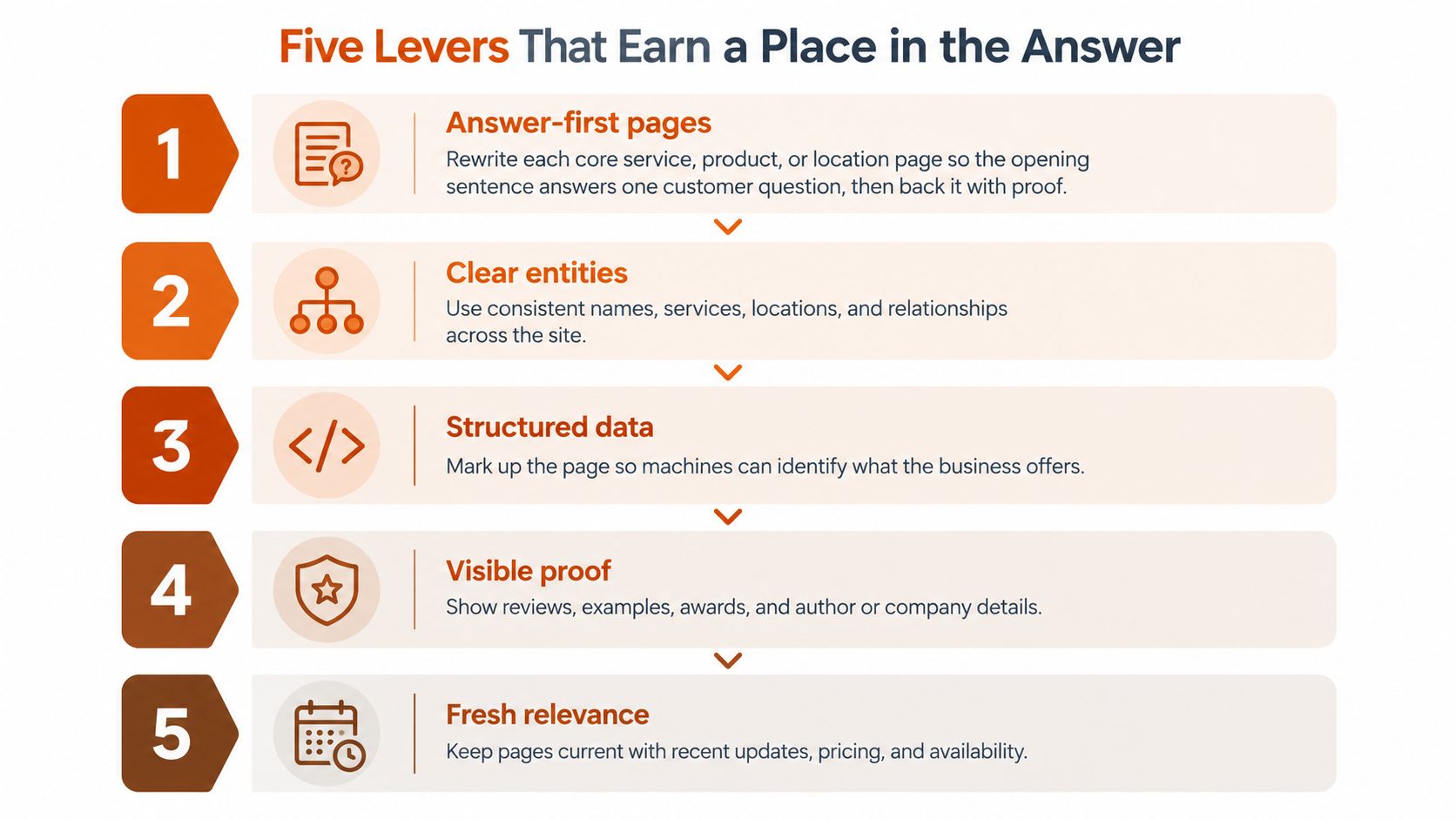
The work is practical: improve the pages and signals a team can control, then check whether assistants use them.
-
Write answer-first pages. Start each core service, product, or location page with a direct answer to one customer question. Then substantiate it: who the offer is for, where it’s available, what it includes, and what evidence supports the claim. “We provide HVAC repair across North Shore” is more useful to a buyer, and more quotable, than a broad slogan about dependable home comfort.
-
Make the business and its offer explicit. Use accurate Organization, Service, FAQ, and Article structured data where it fits the page. Keep the business name, offerings, locations, and relationships consistent in the page itself. Google doesn’t require special markup for AI Overviews, so treat schema as a way to clarify meaning, not a switch that earns citations.
-
Confirm crawl access. Check that important pages are reachable, indexable, and available as clean HTML. Keep an accurate sitemap with full page URLs, and review robots.txt for accidental blocks. For ChatGPT search, allow OAI-SearchBot if you want your site to remain eligible for its search answers. OpenAI distinguishes that search crawler from GPTBot, a separate setting for training-related crawling; the controls are independent. OpenAI says that sites opting out of OAI-SearchBot won’t appear in ChatGPT search answers, though they may still appear as navigational links, according to its crawler documentation.
-
Keep one set of business facts. Align your website with your Google Business Profile, directories, and review profiles. If the website lists one service area and a directory lists another, an assistant has to reconcile the conflict. That ambiguity can weaken the answer or lead to a wrong description.
-
Build corroboration. Earn relevant third-party mentions that reinforce the same facts as your own pages. A publication or directory that clearly identifies your service and location gives assistants another source to interpret, while improving the consistency of the wider web presence.
Working sequence: Publish the page, confirm it’s reachable and not blocked, submit the sitemap, request a recrawl, then ask the original customer question again.
AnswerLion’s Fix work rewrites key pages to answer questions directly, adds structured data, and makes the business consistent across the web. For a closer look at how AI brand mentions fit into this work, examine whether assistants name the business unprompted, not just whether they cite a page.
How Priority Questions Look in Practice
Start with the question the buyer asks. The page should answer that question clearly enough that a reader can tell whether the business fits, and an assistant can extract the same point without guessing.
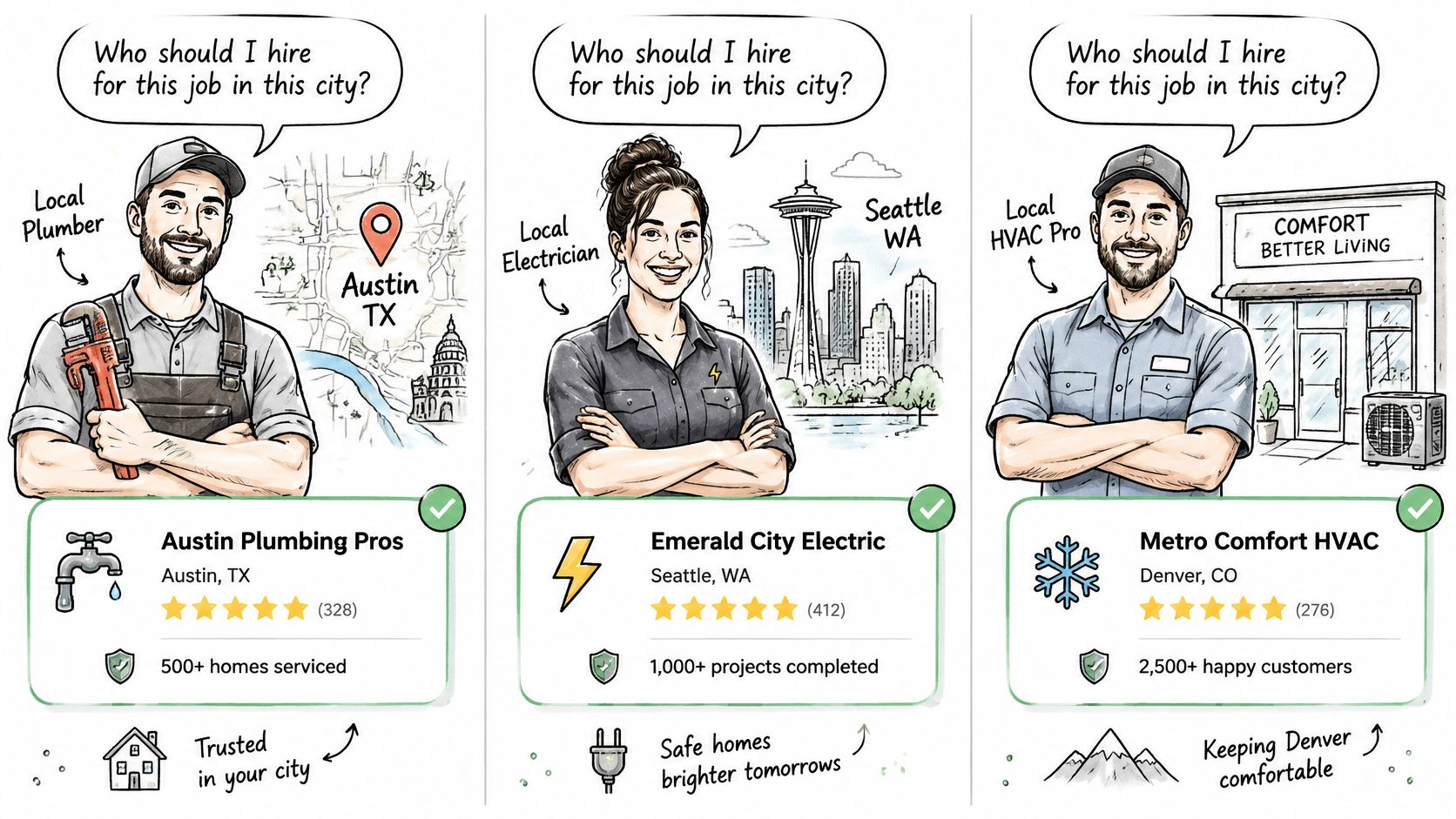
Local service: “Who should I hire for this job in this city?” A strong opening names the service, the area served, and a relevant proof point. For example: “Our licensed electricians install panel upgrades across the west side of the city, with a written scope provided before work begins.” If the company’s directory profiles describe a different service area, the page and profiles send conflicting signals. A generic claim like “Your trusted home experts” doesn’t tell the buyer, or the assistant, whether the company fits the job.
B2B SaaS: “Which platform fits a team with this constraint?” State the fit, the boundary, and a comparison point the buyer can use. A product page that lists integrations may earn a citation for a specification while another vendor gets named as the better choice. Make the opening answer the selection question: “This platform suits distributed teams that need approval workflows across multiple departments, but it isn’t designed for teams seeking a no-setup personal task manager.”
E-commerce: “Which product is right for this use?” Give the relevant attributes, compatibility, and intended user. A category tagline may describe the collection without distinguishing the right item. A specific product passage should tell the shopper what it works with, what need it addresses, and which limitation matters before purchase.
Content changes can influence visibility, but the best approach depends on the category. Princeton researchers’ GEO-bench reported that optimization could increase visibility in generative-engine responses by up to 40%, with strategy effectiveness varying across domains, in their Generative Engine Optimization benchmark research.
Test a page revision against the same question list and competitor set. A tactic that helps buyers compare software may not help them choose a local contractor.
Choose three revenue-driving questions. For each one, write the exact sentence you want an assistant to quote, then record which business it names today. That gives the team a focused test instead of a vague mandate to “optimize for AI.”
Citation Recommendation and Commercial Impact
A citation can put a business’s evidence in an answer without making it the recommended provider. A 2026 review reported that, in 69% of cases where a brand’s own “best X” page was cited in a Google AI Overview, a competitor was recommended instead, according to the review of AI citation outcomes. That gap is why a citation count alone can give a misleading account of commercial progress.
Track four outcomes against the same customer questions. Run the questions across the major assistants, then record what each answer says and which pages or businesses it uses.
| Outcome | What a positive result looks like | What it does not prove |
|---|---|---|
| Citation | The page is used as a source in the answer | That the business is the one recommended |
| Recommendation | The assistant names the business as the provider to choose | That every factual detail is current |
| Description accuracy | Name, offer, and location match the business today | That recommendation share is already high |
| Commercial impact | AI answers contribute referral visits or assisted conversions | That citation volume alone is pipeline |
Citation means the page supports the answer. Recommendation means the assistant presents the business as a provider to choose. Those measures overlap, but neither guarantees the other. A SaaS pricing page may substantiate a feature comparison while the answer favors a competing platform.
Accuracy tests whether the assistant has the current business name, offer, and location right. Commercial impact connects AI answers to the next step: referral visits and assisted conversions. If a user arrives after seeing an answer, analytics and lead records can help teams assess whether that interaction contributed to a sale.
The decision path usually develops in stages: assistants describe a business accurately, then name it for targeted questions, then cover related questions as authority grows. Track what happens for each prompt: whether the business appears, how the assistant describes it, which source it cites, and which competitor it recommends. When a page is cited but another provider wins the recommendation, report recommendation share beside citation count so the gap stays visible.
Why Engines Skip or Misstate a Business
A strong website can still feed assistants stale or contradictory facts. An old address on a directory, a retired product in an article, or a service the business no longer offers can all give an assistant material to repeat. If the company’s own page describes its offer vaguely, the assistant may fill the gap with a category assumption or a competitor’s framing.
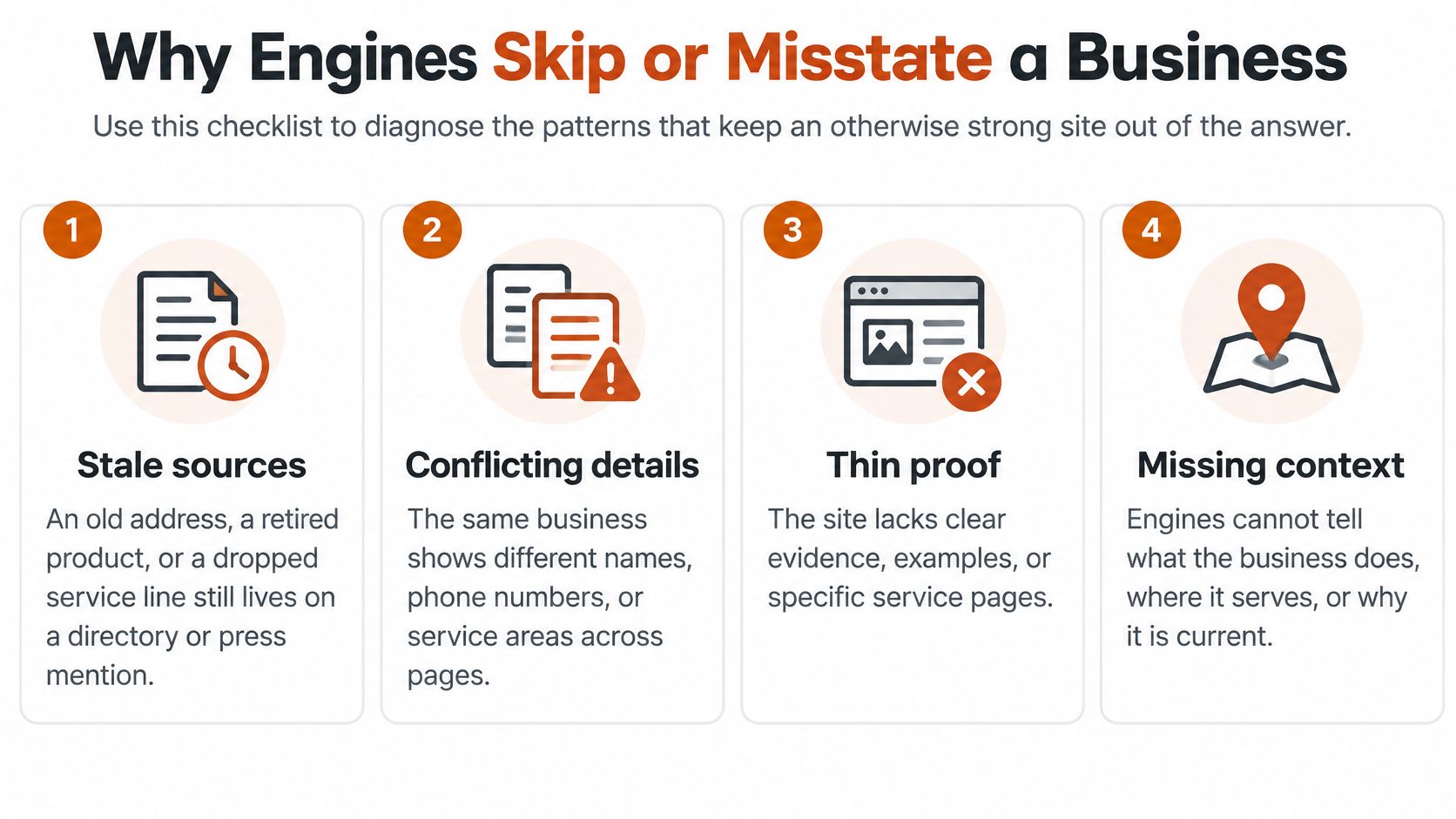
Conflicting profiles create another problem. When the website, business profile, and directory disagree on a name, phone number, or service area, the answer can blend details from different sources. An audit should identify not only what is wrong, but where the assistant may be getting that information.
Trust signals don’t automatically prove accuracy. A large-scale experiment covering roughly 12,000 queries across seven countries and about 80,000 search results found that citations increased trust in generative-search answers even when links were incorrect or hallucinated, as described in the study on citation effects in generative search. Businesses should verify that the cited page supports the claim and that the claim remains current.
Crawl access matters, too. A key page behind a login, marked noindex, or blocked from the relevant crawler can’t serve as a dependable public source. For ChatGPT search, blocking OAI-SearchBot takes the site out of search answers, even though it may remain available as a navigational link.
Separate corrections by the kind of work involved. Fixing a wrong description can show up after engines recrawl the corrected page. Building authority through new third-party mentions takes longer and can broaden the questions a business is able to answer credibly.
Ask a priority question in a fresh session on each major engine. Record every wrong detail and every named source, then correct the source the assistant is actually reading.
When an answer contains an inaccurate detail, trace it to the page or profile behind it instead of editing the homepage by reflex. This guide to correcting an AI description of your business can help teams distinguish a source problem from a wording problem.
Start from a Baseline of Customer Questions
A marketing director can begin with a straightforward decision: build a short list of buyer questions and run each one through ChatGPT, Perplexity, Claude, and Google AI Overviews. For every answer, record whether the business is named, how it’s described, which sources appear, and which competitor the assistant recommends instead.
That record becomes the working baseline. Fix inaccurate descriptions first, because customers and assistants need the right name, offer, and location. Then focus on recommendations for the questions most closely tied to revenue. The AEO visibility audit guide offers a practical way to assess what assistants say and identify where another business is winning the answer.
AnswerLion is an answer engine optimization agency that helps businesses get cited and recommended by ChatGPT, Perplexity, Claude, and Google AI Overviews. Its work can include a priority-question audit, answer-first content, structured data and technical setup, authority and citations, and ongoing monitoring and reporting.
The essential first deliverable is not another ranking snapshot. It’s a documented picture of today’s answers and a prioritized order of fixes, so the team can improve how assistants describe the business and earn recommendations for the questions buyers ask.
Start with an AEO audit from AnswerLion to see which businesses assistants cite and recommend for your priority questions, and where your own facts or pages need work. Visit AnswerLion to build a clear baseline and a practical plan for becoming the business buyers see in the answer.