 AnswerLion
AI SEO agency
How to Choose an AI SEO Agency for Better Visibility
Choose an AI SEO agency with confidence. Learn which services matter, how to compare providers, and what outcomes to expect across AI engines.
Published · Updated · By AnswerLion

Your search rankings look healthy, your team publishes useful content, and your agency reports steady progress. Then you ask an AI assistant to recommend a provider in your category. Competitors appear, but your business doesn’t, or the assistant describes an offer you stopped selling.
That’s a different buying problem from slipping down a results page. Choosing an AI SEO agency means finding a partner who can diagnose that gap, implement lasting improvements, and show whether better visibility creates qualified demand. Start with evidence and accountability, not the size of the agency’s AI toolkit.
Table of Contents
- Why AI Visibility Needs a New Agency
- What an AI SEO Agency Actually Does
- Core Services That Drive AI Visibility
- How to Evaluate an AI SEO Agency
- Compare Agency Models for Your Business
- What an Effective AEO Engagement Looks Like
- Measure Outcomes Beyond AI Citations
- Build a Confident Agency Shortlist
Why AI Visibility Needs a New Agency
A marketing director in that position doesn’t need another presentation about the future of search. They need to know which customer questions leave their business out of consideration, why those omissions happen, and what the team should change.
Conventional SEO still matters. But a strong ranking doesn’t answer every commercial question about how a business appears inside a generated recommendation. Buyers may encounter a summary, comparison, or shortlist before deciding whether to visit any website.
The customer’s decision can happen before the click
In Pew Research Center’s analysis of Google browsing behavior, users clicked traditional results during 8% of visits with an AI summary, compared with 15% without one. That’s a concrete reason to evaluate your presence inside the answer, rather than judging discoverability exclusively through website visits.
Consider a buyer asking which service provider supports their location and meets a particular operational requirement. An assistant’s answer might omit your company, misstate your coverage, or recommend a competitor using a clearer description. Each problem calls for a different intervention.
Buying principle: Hire an agency to resolve documented customer-discovery problems, not to deliver an impressive collection of AI assets.
Define the commercial problem before replacing the partner
Start by distinguishing between absence, inaccuracy, and weak positioning. Absence requires investigating whether relevant evidence is available. Inaccuracy requires tracing conflicting facts. Weak positioning requires examining whether your content explains why the offer fits the buyer’s situation.
The distinction between AEO and SEO helps frame the agency conversation: preserve the search foundations that work while adding explicit accountability for generated answers.
You may need a specialist, an expanded incumbent relationship, or internal ownership with external support. The right choice starts with the problem, not the label on the proposal.
What an AI SEO Agency Actually Does
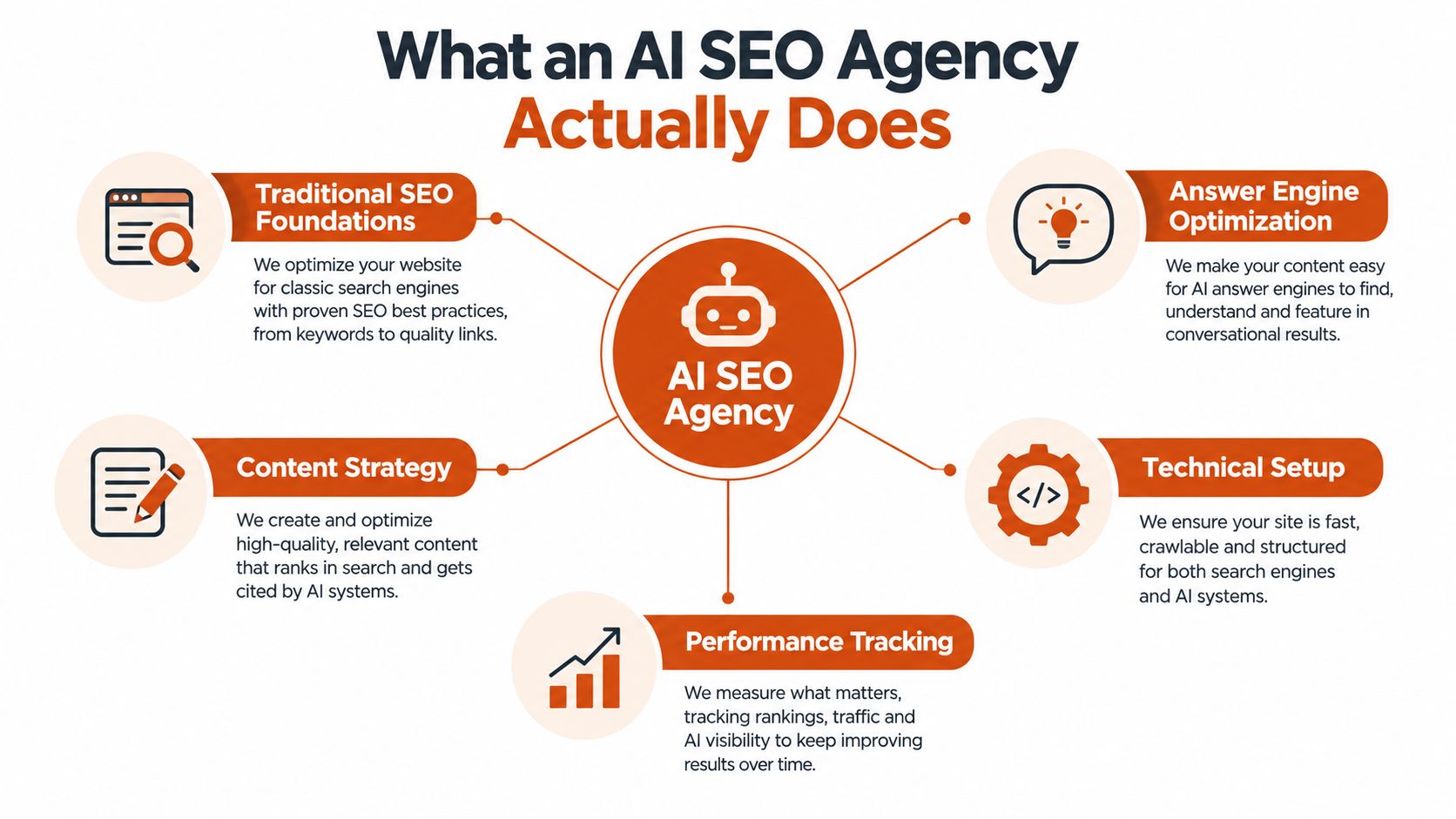
An AI SEO agency connects your business’s public information with the questions customers ask in search and AI interfaces. Its work combines SEO foundations, answer engine optimization, machine readability, entity consistency, and visibility measurement.
The distinction is practical. Traditional search work targets discoverable, competitive pages in ranked results. Answer engine optimization, or AEO, also examines whether an assistant names the business, cites its information, describes it accurately, or recommends it for a relevant need. Those are separate observations, and a useful agency records them separately.
The service model brings editorial, technical, and analytical work together.
Diagnose understanding before adding content
Suppose an assistant describes your implementation service as a self-service software product. Publishing more articles about the category won’t directly resolve the misunderstanding. The agency should inspect your product descriptions, service pages, public profiles, and relevant third-party references to locate the ambiguity.
It should then translate that diagnosis into changes people can review: a clearer opening definition, explicit delivery details, consistent terminology, and supporting evidence. Recognizable business facts matter more than language written merely to sound optimized.
Technical investigation belongs alongside that editorial work. Google’s JavaScript SEO documentation describes crawling, rendering, and indexing as sequential phases. Important content dependent on failed or blocked JavaScript may be missing from the rendered representation Google uses.
Separate availability from persuasiveness
A mature agency distinguishes an ingestion problem from an information problem. If the primary answer isn’t reliably available to crawlers, technical implementation comes first. If it’s accessible but vague, contradictory, or poorly supported, the priority changes.
Ask the provider to show how it reaches that diagnosis:
- Availability evidence: Raw and rendered page checks showing that important answers and links are accessible.
- Meaning evidence: A comparison between your intended business description and the assistant’s actual response.
- Action evidence: Specific page or profile changes tied to the observed mismatch.
That connection between diagnosis and execution is the substance of AEO. Tools support the work; they aren’t the work itself.
Core Services That Drive AI Visibility
A useful proposal should connect each service to a customer problem, an implementation task, and an observable result. Think of your business as a storefront: customers need to understand the sign outside, find answers inside, and recognize the same business in public directories.
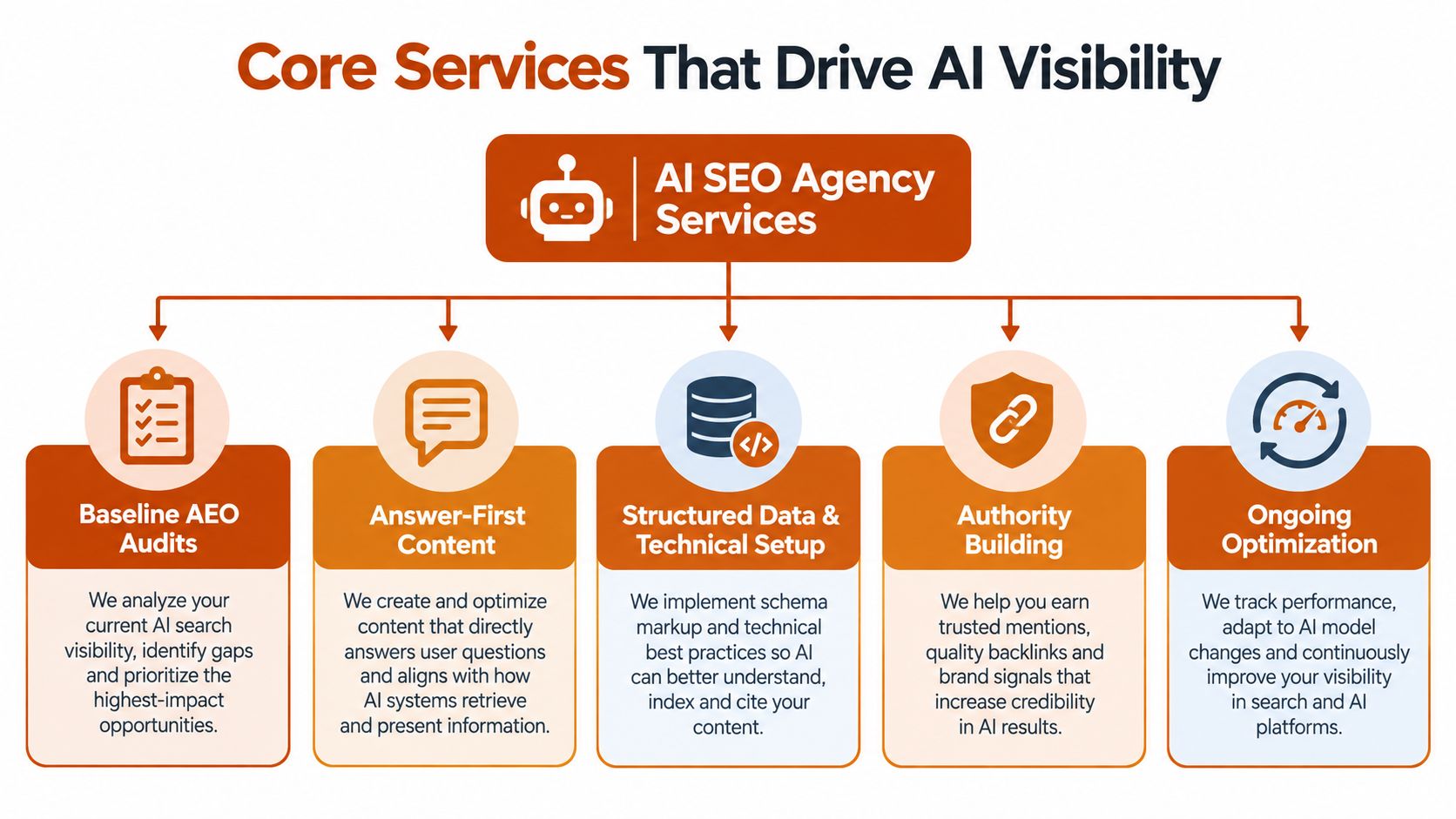
The agency’s operating model should make those connections explicit.
Establish the baseline and improve the answer
Baseline AEO audits should begin with priority customer questions, not a generic keyword export. The agency records the responses, named competitors, cited pages, inaccurate statements, and omissions. The deliverable is a documented starting position and a prioritized explanation of the gaps.
Answer-first content addresses pages that make readers work too hard to understand the offer. A service page should answer its central question immediately, then explain eligibility, scope, process, and relevant limitations. Replace an opening about corporate ambition with a direct statement of what the service does and whom it serves.
Supporting FAQs should resolve genuine buyer uncertainty. A practical FAQ schema example can help teams review implementation, but the underlying answers must be useful without the markup.
Build a dependable technical and factual foundation
Structured data should represent the business accurately, not decorate an unclear page. Google’s structured-data policies recommend JSON-LD and require markup to reflect visible content; technical validation alone doesn’t establish eligibility for enhanced results.
Review Organization, Service, Product, Article, and location information as a connected system. Names, descriptions, offers, service areas, and contact details should agree with the rendered copy and authoritative listings.
Discovery also needs deliberate implementation. Google’s sitemap guidance treats submission as a hint, not an indexing command, and explains how a Sitemap directive in robots.txt supports discovery. The deliverable should therefore include verified canonical URLs, indexability checks, and sitemap coverage, not only a newly created file.
Strengthen references and maintain the work
Authority work should focus on accurate, relevant external evidence. Ask the agency to distinguish correcting an existing listing from earning a new editorial reference.
- Authority and citations: Review directories, publications, and review profiles; correct material inconsistencies; pursue relevant references that substantiate the business’s expertise.
- Recurring monitoring: Revisit the agreed questions, compare cited sources across engines, and identify which remaining gaps deserve implementation effort.
- Maintenance ownership: Assign responsibility for updating content, markup, and profiles when services, locations, or product details change.
A finished asset is a deliverable. Verified use of accurate information is a stronger sign of progress.
Buy the connected service, not disconnected packages of content, schema, and reports. The proposal should explain how the team will move from an observed omission to a shipped change and a subsequent assessment.
How to Evaluate an AI SEO Agency
Ask shortlisted agencies to demonstrate their method using a relevant customer question. A polished explanation is useful; a traceable chain from observation to recommendation is more persuasive.
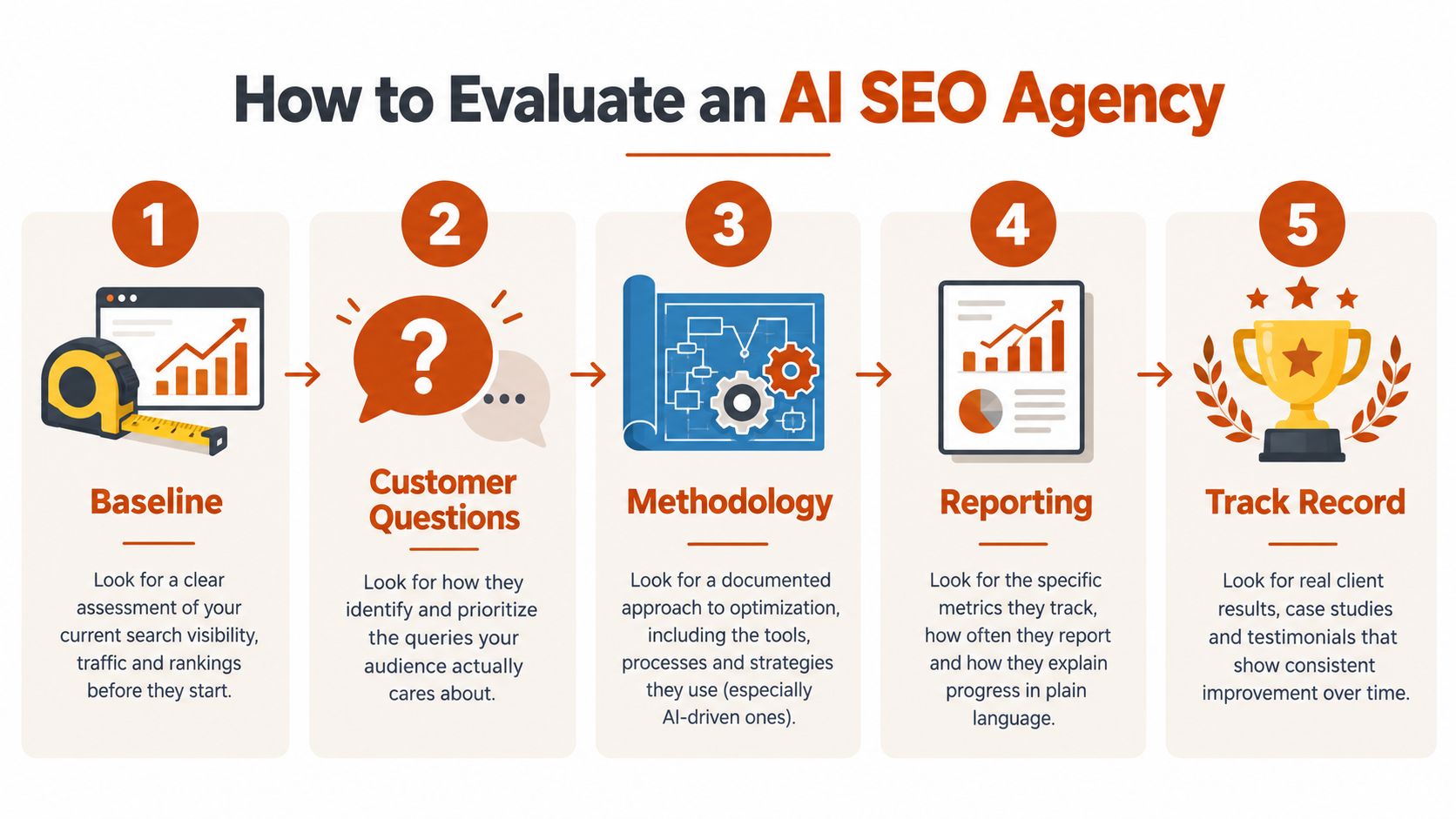
Use an evidence-led evaluation process.
Inspect the evidence behind the proposal
- Baseline: Request the prompt wording, response date, engine, cited sources, and competitor observations. Screenshots should support a documented record, not replace it.
- Customer relevance: Ask how questions were selected from sales conversations, support needs, product requirements, and local buying decisions. Prioritization should reflect your commercial objectives.
- Methodology: Have the agency trace an omission to a proposed change. It should explain what evidence supports the diagnosis and how implementation will be checked.
- Reporting: Review a sample that separates mentions, citations, recommendations, and factual accuracy by engine. Ask whether your team can inspect the underlying observations.
- Track record: Request permissioned examples showing the starting problem, shipped work, and resulting business evidence. Look for a clear explanation of what the agency contributed.
A screenshot of a favorable answer doesn’t establish repeatable progress. Likewise, a technical audit isn’t implementation. Confirm who writes the copy, changes templates, coordinates developers, approves claims, and verifies the release.
Test governance and operational fit
Access decisions deserve executive attention. A study of AI-agent blocking reported that 60.0% of reputable websites blocked at least one AI agent, compared with 9.1% of misinformation websites, as of May 2025. The practical question is which materials your organization should expose, restrict, license, or keep private.
Ask the agency to distinguish public product information from customer records, unpublished research, proprietary assets, and regulated claims. It should involve security and legal stakeholders where appropriate, rather than treating unrestricted crawler access as the objective.
Also examine the working relationship. Who owns the prompt library and reporting history? What happens when your developers can’t implement a recommendation? How will the agency compare your business with competitors that appear in sales conversations?
Choose the provider whose process remains understandable after the sales meeting. A mature partner makes priorities, dependencies, decisions, and unresolved issues visible to the people funding the work.
Compare Agency Models for Your Business
The best operating model depends on your team’s capabilities and where execution currently stalls. Evaluate the available options against the same requirements: baseline measurement, technical implementation, multi-engine coverage, answer-first content, and accessible reporting.
AI SEO Agency Model Comparison
| Agency model | Best fit | Core strength | Buyer should verify | Key limitation |
|---|---|---|---|---|
| Traditional SEO agency adding AEO | Businesses with a capable incumbent and a manageable visibility gap | Continuity across existing search and content work | Explicit AEO methodology, engine coverage, and reporting beyond rankings | Existing deliverables may dominate the engagement |
| Specialist AI SEO or AEO agency | Teams needing focused diagnosis and dedicated answer-visibility ownership | Concentrated attention on generated answers and related implementation | Technical execution capacity, business alignment, and transparent evidence | Requires coordination with established marketing and development teams |
| In-house team | Organizations with available SEO, content, engineering, and analytics expertise | Direct access to product knowledge and internal priorities | Protected capacity, repeatable testing, and accountable ownership | Competing responsibilities can delay delivery |
| Blended model led internally | Companies with complex approvals, locations, or product portfolios | Internal control combined with external specialist support | Clear handoffs, shared records, and release responsibility | Ambiguous ownership can slow decisions |
Choose around the implementation bottleneck
A smaller marketing team should prioritize delivery capacity. If nobody internally can rewrite pages or coordinate technical changes, an advisory-only engagement leaves the most important work unfinished.
A technically mature company can make better use of specialist diagnosis. Its engineers and editors may already have the skills to implement improvements, while an external adviser supplies the testing method and prioritization.
For a multi-location organization, operational coordination deserves particular weight. Local managers, central marketing, directory administrators, and developers need an agreed process for approving and distributing changes.
Decision test: Select the model that removes your execution bottleneck while preserving clear internal accountability.
Make reporting accessible across the relationship
Don’t accept separate reporting systems that prevent teams from comparing findings. Whether you hire a specialist or expand an incumbent’s scope, require a shared understanding of the questions being tested, the evidence collected, and the work completed.
A blended model is a strong choice when internal stakeholders must control claims and releases. An end-to-end partner is preferable when your team needs execution as well as advice. Neither arrangement succeeds through specialization alone; someone must own the path from diagnosis to deployment.
What an Effective AEO Engagement Looks Like
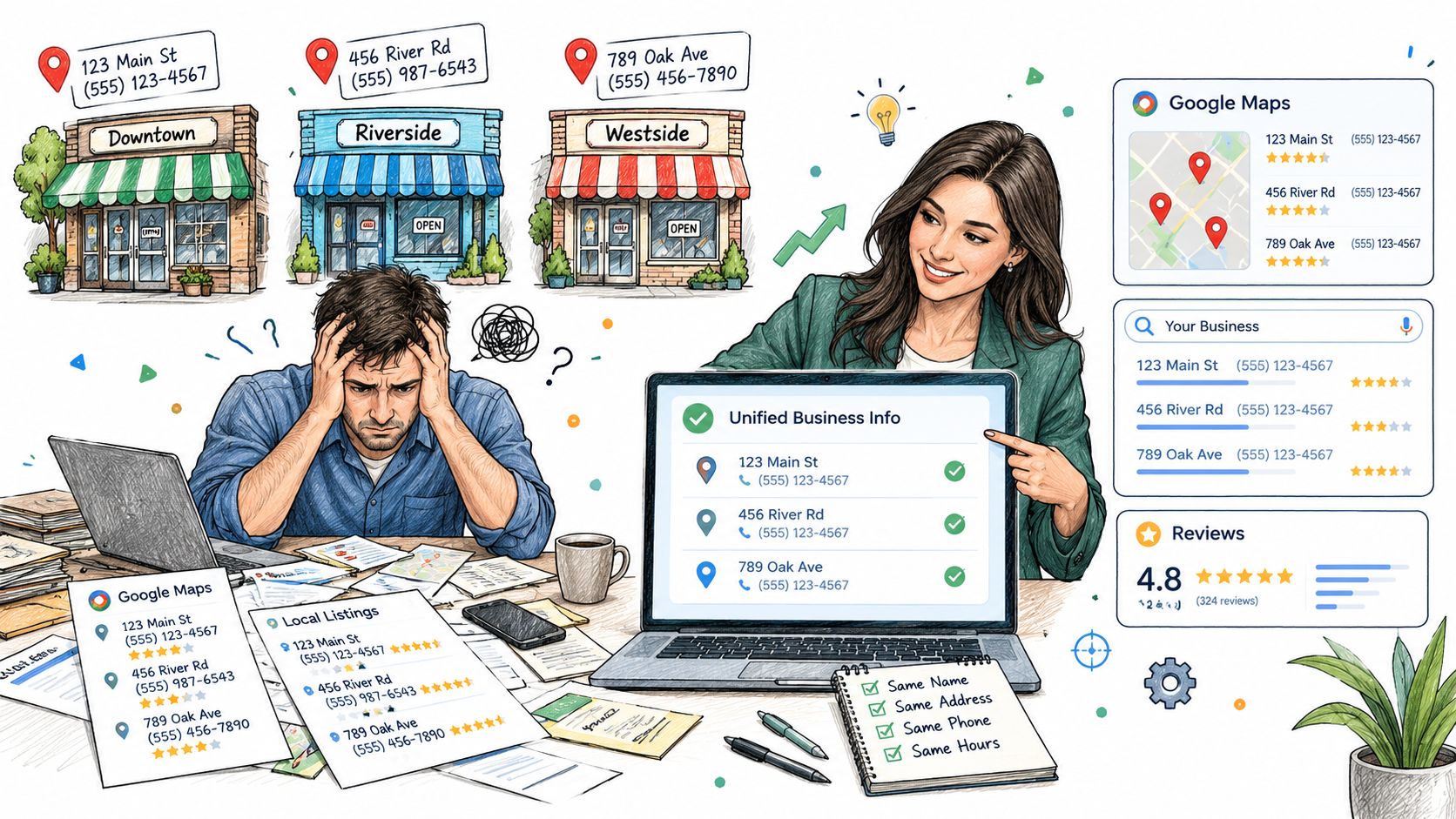
Consider a hypothetical multi-location service business whose public information differs across platforms. The engagement starts by identifying the conflicting records and the customer questions affected, rather than immediately producing more location pages.
Consistent information requires coordination between the people managing the website and those maintaining external listings.
A local service business needs location-level clarity
In this illustrative scenario, a location page fails to explain whether a particular service is available in the buyer’s area. The agency documents the answer gap, confirms the correct service coverage with the business, harmonizes relevant listings, and rewrites the page around that local need.
The team then aligns structured data with the approved information and monitors whether subsequent responses describe the location correctly. The useful success signal is accurate inclusion for an eligible customer, not merely another indexed page.
Product businesses need a different evidence set
A B2B SaaS company may need clearer descriptions of capabilities, integrations, deployment requirements, and support. Its engagement should prioritize comparison questions and ensure that product claims have an approved factual basis. Sales and product leaders should review those statements before publication.
An e-commerce business should focus on category distinctions, product attributes, compatibility, delivery information, and support answers. Merchandising teams need a maintenance process so discontinued products and outdated policies don’t remain in the content being optimized.
These are representative scenarios, not reported client results. They illustrate why the agency should adapt its priorities to the business instead of applying an identical content template.
The accompanying video provides additional context for the agency discussion.
Across these engagements, require a practical handover: approved facts, changed URLs, implementation records, unresolved dependencies, and the questions scheduled for reassessment. That gives internal teams something they can maintain and audit.
Measure Outcomes Beyond AI Citations
An AI citation is evidence of visibility, not proof of commercial success. A buyer may read the answer, remember the brand, visit later through another channel, or decide they’ve learned enough without visiting at all.
Ars Technica’s discussion of AI Overviews and website clicks highlights the tension between reduced click activity and Google’s claim of improved click quality. Marketing leaders should resolve that question with their own business evidence rather than treating exposure and demand as interchangeable.
Separate visibility from downstream value
Build reporting around distinct categories:
- Answer presence: Citation share, recommendation frequency, factual accuracy, and competitor inclusion.
- Demand signals: Branded searches, attributable referral visits, and relevant self-reported discovery information.
- Commercial outcomes: Qualified leads, assisted conversions, pipeline, and revenue, with the attribution method stated clearly.
Segment the observations by intent. Informational prompts support education; comparison prompts concern consideration; local prompts require geographic relevance; high-intent commercial prompts concern readiness to buy. A citation in each category has a different business interpretation.
Use measurement to make the next decision
Establish a fixed priority-question set and preserve the historical responses. Re-run those questions, inspect relative movement across engines, and annotate the content or technical changes made between observations.
A useful LLM visibility tracking framework should make that history inspectable. Keep engine-level results visible rather than compressing every observation into an unexplained aggregate score.
Report what changed in answers, what changed in qualified demand, and what evidence connects the two.
Where a connection isn’t established, describe visibility as a leading indicator. Where qualified outcomes are observable, use them to prioritize further investment. That distinction makes the report more useful to a CMO than a dashboard full of citation counts.
Build a Confident Agency Shortlist
Shortlist agencies that can document the starting position, implement lasting changes, manage factual consistency and access decisions, and explain movement across engines in business language.
During consultations, ask these final questions:
- Starting evidence: What will you record before making changes?
- Priority decisions: Which customer questions deserve attention first, and why?
- Implementation ownership: Who will ship and verify the recommended work?
- Governance: How will you handle sensitive information and approve public claims?
- Business reporting: How will you distinguish visibility progress from qualified demand?
Request a proposal you can evaluate
Ask each provider to submit its proposed methodology, concrete deliverables, implementation responsibilities, and measurement plan. Compare those proposals against the same customer-discovery problems rather than accepting differently packaged service lists.
Avoid choosing solely on ranking promises, tool volume, or a generic inventory of technical assets. Prefer the partner who can explain why a particular change deserves your resources and how the team will assess it afterward.
Your next step is a working consultation with real customer questions and representative pages. Leave with a scoped diagnostic and clear ownership, not just another presentation.
AnswerLion offers baseline AEO audits, answer-first content, technical implementation, citation work, and ongoing cross-engine reporting. Visit AnswerLion to compare its documented capabilities with your shortlist and request a proposal built around your priority customer questions, implementation needs, and measurement goals.